
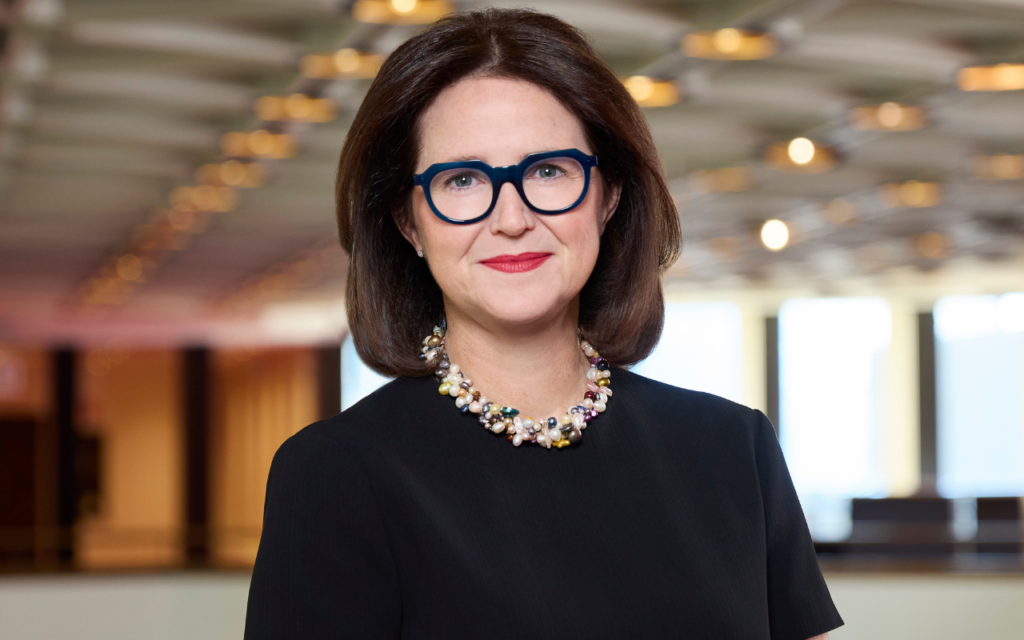
Growing up, Annabelle Cloutier vividly remembers her childhood home being filled with music.
“It was always around,” she said, smiling, recounting how her mom played piano and conducted community choirs, while her dad played the fiddle. “For them, it was important that all of us learned an instrument.”
For Cloutier, that ended up being piano and violin, which she trained in for a number of years. But little did she know that love of music would eventually come full circle in her life.
Today, Cloutier’s days are still filled with symphonic sounds as she leads the team at the National Arts Centre, where she became President and CEO in December 2025. She is also the first Francophone woman to lead the national institution since its opening in 1969.
Now almost a year into the role, she says it still feels like a pinch-me moment.
“I never expected art to come back into my life this way,” she said. “I never thought I would eventually lead this place…but here I am. I feel so honoured and so blessed.”
The road to the top
Like many leaders before her, Cloutier’s journey to the C-suite was not a direct path. But no matter where she ended up, her passion for the arts remained constant.
While studying law at Sherbrooke University, she got her first taste of managing an arts and culture project, producing the annual Faculty of Law talent show.
“I threw myself into that project, and it was pretty successful! It was the first year it didn’t lose money, so they started calling me the godmother of the event,” she joked. “But that experience made me realize that this was something I was really good at. Bringing people together, leading a team, harnessing all the talent and the idea and vision, and making it concrete.”
Despite that initial success, Cloutier continued down the pathway to law, earning her degree and launching into the practice of law. But she admits something was missing.
“I was good at law, but I was not passionate about it,” she explained. “I could sense there was not a real fulfillment for me.”
What she was looking for was a route back to working in events, arts and culture, which she eventually found by joining Radio Jeunesse, a French-speaking youth radio station in Ottawa-Gatineau.
“It was a difficult decision to leave law, and I remember my family looking at me like, ‘What are you doing?’” she said. “You’re thinking to yourself, ‘Am I turning my back on a great career? Financial stability and all of that?’ I was entering into something really uncertain. But I had to trust my own gut and make the leap.”

That leap would eventually lead her through a number of roles, including with the Fédération culturelle canadienne française, a French-language arts advocacy group, and the Governor General’s office. In 2018, she landed at the NAC, where she was hired by then-president Peter Herrndorf as the final hire of his 19-year tenure.
“Those years in my early 20s were instrumental in the trajectory for my career,” she added. “And a lot of times during those years I was scared, but I also knew that your fears are your limits. My best advice to other women is to lean into that doubt and discomfort. I know it’s not easy…there are still moments now where I’m doubting and unsure, but I’m trying to quiet that voice.”
The best of Canadian art
Now at the helm of Canada’s premier performing arts centre, Cloutier is looking at everything with fresh eyes.
“I told the team, ‘Imagine I don’t know anything… imagine I am completely new here’,” she explained. “I felt it was important that I offer myself and others the grace to start from scratch. It’s been very fast-paced, but it’s been incredible to really understand the operations and complexity of what we do here.”
The NAC is a robust institution, with its own orchestra, three theatre streams in English, French and Indigenous languages, dance and popular music programming, a restaurant and a national mandate that extends far beyond its Ottawa home.
It’s a responsibility that Cloutier does not take lightly.
“Canadians are facing a lot of new challenges, but we’re in a moment where Canadians are, I think, seeing even more value in what it is to be Canadian, and feel even more connected to our culture and nurturing what connects us,” she said.
“Artists are at the forefront of that. They’re trying to translate back to us what we’re experiencing, so arts and culture are instrumental to our identity, and I hope the NAC is playing our part in showcasing Canadian talent and supporting that.”
As the team kicks off its new season, Cloutier is looking ahead to what the NAC can do both on its stages and beyond Ottawa.
The institution regularly invests in productions and partnerships with arts organizations “from coast to coast to coast”, while also supporting touring acts that not only appear on NAC stages but that travel across the country and abroad, so Canadian stories reach wider audiences.
“I have ambitions for us to continue to do that with excellence, and with relevance,” she added.
Leading at a larger scale
With a big year ahead, and the NAC’s 60th anniversary on the horizon in 2029, Cloutier is feeling energized about what’s to come. But for all of her plans, she knows there is still plenty she wants to learn.
“I am going to gain and learn so much from these connections and conversations I am having all over the country, and I think this role is going to teach me to not remain set in my ways but really evolve,” she said. “I often talk about being the best version of yourself…I know I will grow here. I will grow into a new stage of my ability to lead at a larger scale.”
That openness to learning is something she plans to carry with her, particularly as she thinks about the women earlier in their careers who may be watching her journey.
Cloutier is quick to acknowledge that she has not always had the confidence she has today. She has questioned whether she was ready for the NAC, whether she had what it took to lead the institution and whether she was the person others imagined in the role.
Her advice to younger women is to give themselves the time to grow into their own leadership and build that confidence.
“You have to walk before you run,” she explained. “There are demanding days; there are a lot of things that, when they get to my desk, are really big decisions. I’m now able to do what I’m doing because of accumulated lessons. That resiliency and experience built over time gave me what I need to do what I’m doing.”
She also hopes they feel free to find their own path rather than trying to follow someone else’s.
“I hope they see me and know that you can really truly be yourself and be genuine in whatever role you’re in,” she added.
“And always, always, follow your passion. Do your best work today. What happens today, tomorrow, and in a year from now is only the outcome of what you’re doing today, how you’re doing it, how you engage with others, how you are as a human being, how you build trust with others, how you learn, and how you make mistakes.”

Lisa Thibodeau