On Saturday Night Live, comedian Shane Gillis drew criticism after joking that women at the gym “just dress like whores now,” a remark many viewed as misogynistic and tone-deaf. The comments also landed amid national attention surrounding allegations that a former Cornell University student was sexually assaulted by multiple fraternity members, leading some critics to question the broader cultural context in which such jokes are received.
Critics, including actor Dan Levy, argued that language that objectifies women should not be separated from the broader social conditions in which women experience harassment and sexual violence.
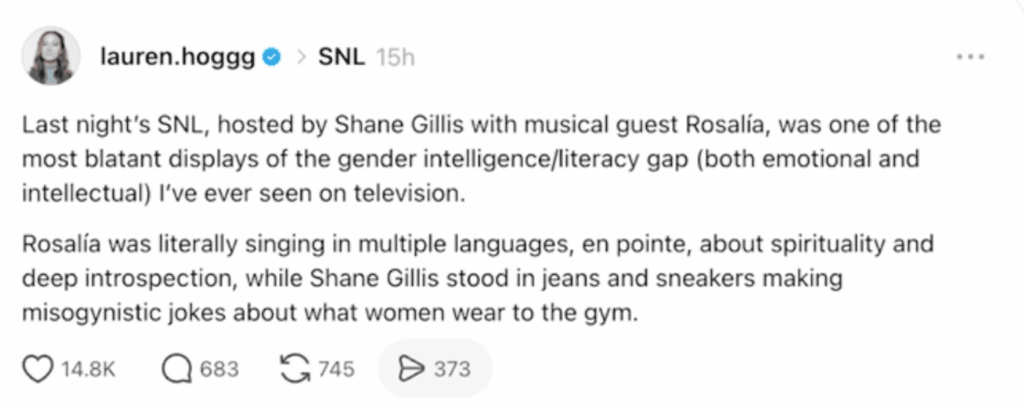
On the same program, musical guest Rosalía performed “Reliquia” en pointe and “Magnolias” beneath an onstage rain shower, creating a striking contrast in tone and presentation. Lauren Hogg captured the contrast in a widely shared post, describing the evening as ‘one of the most blatant displays of the gender intelligence/literacy gap’ she had ever seen. Hogg contrasted Rosalía’s artistic exploration of spirituality and introspection with Gillis’s jokes about women’s bodies.
The juxtaposition is worth reflecting on, not because it is about one comedian, one television show, or one controversial joke.
It is about culture.
More specifically, it is about what happens when misogyny becomes so normalized that people stop noticing it.
One of the most concerning developments of the past decade has been the mainstreaming of ideas once confined to the fringes of the internet. Research suggests that misogynistic ideas associated with the manosphere are no longer confined to isolated online communities. They increasingly circulate through mainstream digital culture and can shape attitudes that people carry into institutions and workplaces.
What was once considered openly sexist is now often reframed as “just asking questions,” “telling the truth,” or “just a joke.”
Organizations should be paying attention.
Because culture is rarely influenced by the most extreme voices. It is shaped by what everyone else tolerates.
The challenge for leaders is that misogyny appears in subtle forms:
· Dismissing women’s expertise while celebrating the same ideas when voiced by men.
· Judging women more harshly for assertiveness.
· Excusing comments or behaviours because someone is “just joking.”
· Remaining silent when women are demeaned or objectified.
· Treating incidents as isolated rather than systemic.
These behaviours may seem minor in isolation, but together they create an environment where disrespect becomes normalized and where the humanity of women is gradually diminished.
The organizational consequences are real. Cultures that tolerate misogyny often struggle with psychological safety, employee engagement, retention, innovation, and trust. Women become less likely to speak up, report concerns, challenge decisions, or pursue leadership opportunities when they believe disrespect will be minimized or excused. What begins as a joke can evolve into a workplace norm about who is valued, who is heard, and who belongs.
Dan Levy made a powerful observation in response to the controversy. He argued that complacency creates the conditions in which sexual violence becomes a conversation instead of being recognized as a crime. He also emphasized that this is not simply a women’s issue but an issue that requires men to speak up and challenge harmful narratives.
Organizational leaders can learn from these communications.
When organizations focus exclusively on individual incidents, they often ignore the culture that makes those incidents possible. Harassment, discrimination, and gender-based violence rarely emerge in a vacuum. They are cultivated in environments where people believe certain groups matter less, where stereotypes go unchallenged, and where silence is rewarded.
Policies alone cannot address this on their own.
Neither can annual training.
The real question is whether leaders are willing to examine the beliefs, assumptions, and social norms operating beneath the surface of organizational life.
· Do employees feel safe challenging sexist remarks?
· Do managers intervene when they hear them?
· Do leaders model respect even when it is inconvenient?
· Do men understand their role as allies rather than bystanders?
Culture is built in thousands of small moments. Every joke that goes unchallenged, every stereotype left unchecked, and every act of silence sends a message about who belongs, whose dignity matters, and what behaviour is acceptable.
The lesson from this weekend is not about canceling comedians or debating free speech.
It is about recognizing that the stories we tell about women impact how women are treated.
Organizations that want psychologically safe, respectful, and high-performing cultures cannot afford to ignore that reality. Misogyny does not become dangerous only when it results in a headline. It becomes dangerous long before that, when people stop seeing it for what it is.
The responsibility of leadership is not simply to respond when harm occurs.
It is to create cultures where harm is less likely to occur in the first place.