
Next time you’re walking through an airport, take a look at the employees around you.
The gate agent checking you in. The baggage handler loading luggage onto the plane. The flight attendant welcoming you on board.
Odds are, you aren’t really thinking about what they’re wearing. A uniform is just… a uniform, right?
Not quite.
Behind every blazer, polo shirt or cargo pant is an entire operation most of us never see – one that’s increasingly focused on making those pieces last longer and stay out of landfills.
It’s a challenge Air Canada is taking seriously.
“We started recycling uniforms in 2017 when we launched our new design,” says Nisha Muire, who manages Air Canada’s uniform program for roughly 40,000 employees. “Since then, our program has grown a lot, and today we’re really trying to focus on circularity. Not only because it’s ethically and morally sound, but we need to do this for our planet.”
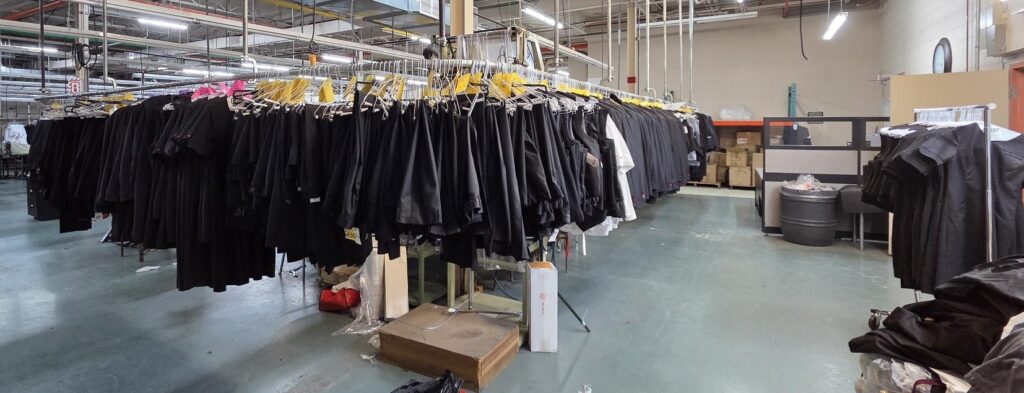
Today, when an employee no longer needs a uniform, it doesn’t automatically end up in the landfill. If it’s still in good condition, it’s professionally cleaned and listed on Air Canada’s uniform app, where other employees can request it free of charge instead of ordering a brand-new piece.
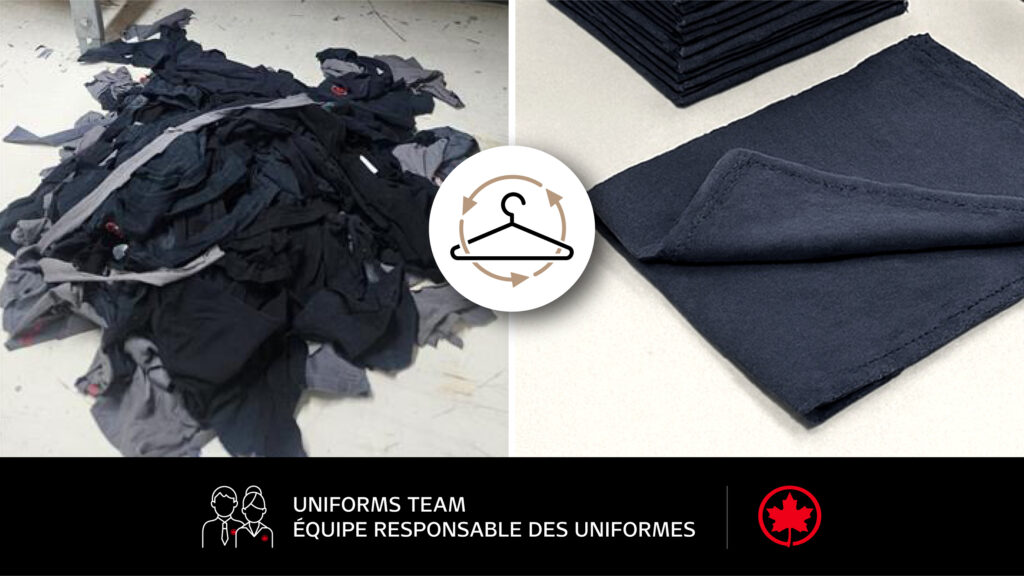
If a garment has reached the end of its wearable life, the company looks for another purpose. Cotton T-shirts, for example, are cut down into cleaning rags for aircraft maintenance teams, extending their use even after they can no longer be worn.
The airline is even finding new homes for thousands of retired flight attendant suitcases, working with La Relance, a Quebec social enterprise, to remove the Air Canada branding so they can be donated or resold.
“Every year, there’s about 92 million tonnes of fabric that end up in landfills. It’s an enormous amount of waste, and we can do our part by minimizing uniform components going into landfill,” says Muire. “Because of this, I really want our program to be more sustainable than the average uniform program.”
That means, in addition to its existing reuse and recycling options, the airline is also exploring new textile technologies that, under the right landfill conditions, could help fabrics biodegrade in as little as three or four years instead of taking decades.
Preparing for the future
For Muire, finding creative solutions like these feels like a natural fit.
Before joining Air Canada, she worked in fashion, eventually joining the airline in 2015. When the opportunity to oversee the uniform program came up in 2017, it brought together everything she’d done before.
Her passion for sustainable fashion also extends beyond the airline industry.
In 2020, after realizing there was no organization dedicated to uniform buyers, she helped found the Uniform Buyers Network alongside the Professional Clothing Industry Association Worldwide (PCIAW) in the U.K.
Today, the network brings together buyers from aviation, transportation, military and security organizations to tackle a question they’re all facing: what happens to uniforms when they’ve reached the end of their life?
It’s a conversation that, she says, is becoming increasingly urgent. Parts of the European Union’s new textile regulations are already being rolled out, with stricter end-of-life requirements set to take effect in 2027.
Rather than waiting for regulations to arrive in North America, Muire says the goal is to be ready before they do – and to help move the industry forward in the process.
“We’re uniquely positioned to say, ‘Let’s do it properly’,” she says. “Let’s set up that infrastructure right now, so that future generations have it already.”
Having worked for over a decade with the airline, Muire says every day brings something new – whether it’s tweaking the fit of a dress after employee feedback, expanding uniform options for different work groups or thinking about how uniforms can better support an increasingly diverse workforce.
And it’s a job, she says, that she’s grateful to do.
“Our brand identity is really conveyed through the uniform,” she adds. “We strive for consistency so that if someone sees us, they know, ‘Oh, that’s an Air Canada employee.'”