
Jennifer Stewart: So I’m really curious, Katie. You spent 10 years at the heart of government in the Prime Minister’s Office, and in the last year and a bit, you’ve had a huge, stark change in your life. You’re no longer essentially helping to run the country. Can you give us some reflections on what this last year has been like for you?
Katie Telford: It’s been great! I was given some advice that I’ve given to lots of people before, but I had to take it myself this time. I’d kind of done a mini version of this previously when I left politics the previous time, which was: take my time, and especially after the number of years that I did it, take your time because you just never know when you first kind of exit such a high-adrenaline, such an intense job, where you want to end up and how you want to transition. And so, take some time to just kind of reconnect with life in a different way and think it through.
So I took a fair bit of time to do that. I also took a whole bunch of chances to travel. I got to come to your Women’s Retreat out at Emerald Lake, and it was kind of a year of a lot of reflection, though I started to do, particularly as the year went on, a bit more speaking and getting out there and seeing what other people had ideas about.
But taking my time was the biggest bit of advice I got, and I think it was really important. Jacinda Ardern’s chief of staff actually said in a book that he was in, where he said it took him seven months to recover, and I then did the math, and I can’t remember what my calculation ended up being, but I can tell you, I was in office a lot longer than him, so I get way more than seven months was my calculation at that time.
Catherine Clark: So I find it interesting that you would be able to take the advice of “take your time” because you lived life at warp speed, and the slowing-down process is hard. Did you find it hard to take your time?
Katie Telford: At different moments, it’s kind of ebbed and flowed over the last year because there’s different things I had to learn or relearn as time went by. I was talking about this with a former colleague who I ran into in the last few days, and we were saying, you know, once the adrenaline wears off and things, you actually have to think through new ways of – I always kept up yoga. I always kept up certain things. I kept up binge-watching Grey’s Anatomy while I was in office. Like, I had my ways to clear my mind, but it’s a different thing to find energy when you’re in that kind of environment versus when you’re not.
And so, as I learned all these different kind of moments, they were adventures unto themselves in the last year. Getting to go to Australia – I was there to speak at a conference, but my family’s from there – and getting to go see them and being able to bring my son on a trip, planning trips, flying commercial, tracking my points – all of those things have been kind of new adventures in the last year.
So it’s intense, but in a more deeply personal way in some ways. And because it’s just been all this new kind of personal revelation of what the next chapter looks like, I really didn’t spend any time. I had no time. Even after Justin, who’s now Justin, the former prime minister, announced his intent to resign, we were in the throes of dealing with the president of the United States and the things that he was saying. We visited Ukraine one last time. There were a number of summits that were still happening in those last couple of months, so we were going full tilt till the very, very last day.
So there hadn’t been a real chance to kind of breathe, sit back, and say, “Where do I want to spend my time next?” which is kind of an exciting thing to have the opportunity to do.
Jennifer Stewart: What, in kind of the last year, have you learned about yourself, and what have you had to unlearn?
Katie Telford: Hmm. Um. I have had to – I mean, some basic things that I’ve had to do a lot more of is, you know, something I didn’t know before I became chief of staff. I can still remember standing in the rain when I first became chief of staff. Jerry Butts, who was the principal secretary at the time, and I were standing in the rain waiting for a taxi when the clerk of the Privy Council walked by us and said, “Where’s your car?”
And we said, “What do you mean?”
And she said, “You clearly haven’t read your full introduction binder yet. You guys, like, you get a car.”
And so we had to learn that existence, and I had it for 10 years, where I could just lift the door, jump in the car. You know, and you hear politicians talk about this a fair bit too, or particularly ministers and former prime ministers. All of a sudden, those kind of pieces go away.
Things like that. You know, all of a sudden, I was driving a lot more and having little experiences like that.
But I also have had to learn – in some ways, I think one of the more personal things is structure is thrust upon you in that job, even when it is completely chaos. It’s organized chaos. It’s not chaotic in terms of the work that you’re doing. It’s chaos because of what’s going on in the world. And so you’re constantly prioritizing and reprioritizing and thinking how to balance the urgent and the important, and you know what you’re doing that day and are you getting the right things done.
So there’s tons going on, but there is a structure and a rhythm to it in this massive team around you of friends and colleagues that you can lean on at the end of a long day. You can wander down the hall and just sit down and have a moment and talk through what happened.
And I mean, we’re all used to working from home more thanks to the pandemic, if you can say thanks to the pandemic. But we’d kind of gone back to the place of being around this big team again, and it’s finding that right balance. It’s staying in touch with people intentionally and making sure to reach out to people who have been huge parts of my life for 10 years.
Like, when people say to me, “Do you miss it?” I miss the people. I miss the ability to wander down the hall. That’s the part I miss. I don’t miss – because I’ve done it for so long – I don’t miss waking up at, you know, five in the morning to read hundreds of headlines that are, yeah, you know, smacking us in the face on whatever the issue is of the day.
Catherine Clark: What’s it been like to spend more time with your son?
Katie Telford: I was always pretty intentional about spending time with him throughout and getting home to him, even if it was to go back out again. But obviously, I was home a lot more, especially in the early days. I’ve started picking up the travel again of late, and it’s actually been interesting watching his reaction to it because in the first number of months – he’s now a teenager – he’s only ever known me in that political environment.
I was actually on maternity leave when Justin first approached me about running his leadership campaign, and so George, essentially, as long as he can remember, he has seen me working in that kind of intense political environment.
So for the first number of months, it was great. Mom was home. And then it was, “When are you going back to work? What’s your job going to be, Mom?”
Then I started getting back on the road, and he started saying, “You’re traveling more than before.”
And I said, “No, I’m objectively not.”
But you get, you know, especially, you get used to the different rhythms of it, and so, you know, it’s been an ongoing adjustment this last year. And as I said, I got to bring him on a trip, which was something I couldn’t do in government, which was just so much fun.
Jennifer Stewart: Before we reflect on your 10 years in politics, what’s been the best thing you’ve done for yourself over the last year?
Katie Telford: I think, actually, just, you know, the thing I said at the outset, which is take the time. And, you know, I talked to a lot of my former colleagues a bit, and, you know, everyone had different pressures and opportunities, and different thoughts around how much time was the right amount of time.
But I know, in talking to a few of them, it’s not even just taking the time as a complete pause, but it’s setting yourself very different types of goals for each day, recognizing that, you know, a couple of meetings in a day is actually not bad.
When I have to be just chalk-a-block, you know, right from the very moment you got up, you were scheduled right through until, you know, into the evening, and kind of changing those expectations and experimenting a bit. And I would say I still am in terms of what the routine looks like now.
I actually think learning to enjoy that and taking to enjoy that has probably been the best thing out of the last year. In addition, of course, to more time with George and more time to just travel with flexibility, where I actually can go see the sights and not just the windowless summit rooms.
Catherine Clark: Katie, you’ve been described as one of the most powerful women in Canada because of the role that you played as the PM’s right hand. Some people said that positively. Some people maybe a little less positively. How did you navigate that label?
Katie Telford: I think that’s diplomatic to say a little less positively. There were definitely people who were less positive about that, but I appreciate that.
I learned with time, and I had to learn pretty quickly. But I certainly had, with time, it – I would say the polarization increased generally in the political universe, but including in terms of social media in particular. And so I had to learn it even more with time.
But I learned to realize it was not about me. The critique and the criticism was usually not about me. If it was actually about me, those people would actually come and talk to me, or they’d talk to somebody around me, so that it would get to me. Like “we think you should do X or Y differently,” and that kind of thing. “It’s time to have your all-staff meeting. You haven’t had one in too long.” Like, that kind of information is going to come at me. Or, “This situation’s not being handled right,” or whatever the case may be.
But the kinds of toxic commentary that would be out there, and even stuff that wasn’t necessarily toxic but that was making a commentary on me without having ever asked me the question or anybody around me, I knew was more a commentary on the broader government or the times, or, if it was toxic, something probably that that person was going through. And there’s probably something that we should reflect on in terms of why is that happening, and, you know, is there anything we can do?
But it didn’t feel personal to me. So the tougher moments in politics are when it feels personal, and usually for it to feel personal, it is coming from somebody that is closer to you.
Jennifer Stewart: Did the security element appeal personal? Because I remember us chatting at Retreat and you saying to me, “You know, I don’t think I’m going to post in real time because, you know, I’m a lightning rod and there are some security issues.” And I thought, “Well, of course there are,” but it dawned on me that that’s kind of the filter that you need to live your daily life through.
Did the security concerns feel personal, and how did that impact you or change the way you lived your life?
Katie Telford: I think it’s fair to say that up until the pandemic, it was not something that I ever really had to reflect on beyond, obviously, the prime minister’s security, which we all spent time thinking about, and historically, as a country, always have.
Then during the time of the pandemic, and particularly coming out of it, that really shifted. And we saw that, of course, in the 2021 campaign. We saw that in terms of some of the protests and just how much vitriol and how aggressive some of them could be, to the point that we had to shut some events down and where they asked me to stay on the bus because they couldn’t keep an eye on me and do what they needed to do for the PM.
And so there were a number of instances then which started to open my eyes to the changed environment.
And then, of course, when the convoy or occupation – or people have different words for it – but when it came to Ottawa, that was a moment too because my name and role got involved and intertwined in some of the stories which came out during the inquiry, and I spoke to them during the public inquiry much later, because they were conspiracy theories attached to my name.
But because of that, I had to be a little more cognizant and aware of things, and it did shift the landscape a bit. And I think it did for a lot of people. So I’m not unique in that sense, but obviously I was in the news for a bit at that point, and especially having been in the role for that long.
And, you know, if there was one thing that could bug me in the job and get to me, it’s comments that would involve my family or my home or something like that, and because I felt very confident at work. There’s a lot of wonderful people who work on Parliament Hill, and even though the parliamentary detail and the protective details are not there for the others around the PM, you always had a sense of security when you were around 80 Wellington, except for that one period of time.
So generally speaking, I felt very secure, but the environment did start to shift, and you did have to think about those things. But I know a lot of public figures who do in other spaces as well, where they’ll wait until after a trip to say where they’ve been just to be extra cautious these days.
Catherine Clark: I want to keep us rooted in COVID, which you brought up, in terms of a changing sense of security, but also a changing dynamic in the country. That was a wild time for you, I’m sure, personally and professionally. When you reflect back on the early days of COVID and how it affected the job that you did, what do you remember?
Katie Telford: Well, I remember a lot, including the very first kind of moment. We’d been seeing briefings and we’d been preparing for different possibilities and talking to the chief medical officer and things for some time, but a moment where things all changed for me from a day-to-day briefing, everything standpoint was when we learned that Sophie had COVID, and it meant that the prime minister was at home, and it meant he couldn’t leave his home by our own views and all the scientific kind of advice at the time and medical advice. He was then quarantined.
And so how do you introduce to Canadians how we needed to kind of act and behave and what we were learning and everything else when we had a prime minister in quarantine?
And so literally overnight, because we found out in an evening, literally overnight, the comms team, everybody, we poured back to the office and came up with the whole him staging a press conference on his front stoop. And we had to sort out – the media advance teams had to sort out how far away, working with medical advice, how far away the reporters should stand from him, and how we would just keep everything safe for those who needed to be there, what the kind of number of staff we could have there would be, where they could go and stand, you know, telling him how to brief him so that he could go out and do this.
Everything changed in that one night. And yet, those press conferences from his front stoop became something that everybody turned to not that long later. But they really started because we all of a sudden had him stuck at home and had to just figure out how to be nimble and adjust all of our strategies to that moment.
I mean, one of the other things that’s hard to remember – it was just so impactful at that time. It’s very easy to remember from a standout moment, but I just dealt with a lot of the chiefs of staff to various premiers and things at the time, and we were all trading information on what we were hearing from our different public servants and advisors and so on as to what needed to be done.
And I can remember getting off one phone call and realizing that on that phone call we had been discussing what would be rates of infection and potential mortality rates that would not create chaos. Like, what is the point at which we would hit a threshold that could create other kinds of instability in our communities and in our cities?
And we were watching what was going on in New York and in Rome at the time. So this was those early days, and, you know, thinking through, well, what is a mortality rate that is going to lead to field hospitals, and where do we set those up?
And obviously, there are all kinds of experts on these things, but just kind of getting off a call like that at the end of a day and sitting there with it and realizing the enormity of what you’re talking about, and then immediately having to tuck that away and say, “Okay, on to the next thing.”
Like, there just wasn’t time to really sit in those moments, and yet that was one phone call in particular because the numbers were just enormous at that time. The fear was real that the projections were going to look really awful based on what we were seeing globally, and so we started to act really, really quickly.
And we were actually, happily, even though there were still a lot of tragedies, overall, the numbers never came anywhere near the ones that I was getting briefed at that time.
Jennifer Stewart: Thank goodness, and I remember that press conference and then all the conferences that followed afterwards. Katie, you’ve worked with Justin Trudeau for many years. What leadership lessons have you learned from him? You know, both positive and challenging.
Katie Telford: So, I think two things on that front that come to mind immediately. One would be a lot of his teaching skills, and it’s funny because there were attacks on him from various quarters in his earlier days of both being a politician, but then of running to be prime minister, that he didn’t have the right experience for the job.
And in some ways, I mean, first of all, you know, as women, we know in particular, experience can be defined in so many different ways. But historically, so many former PMs are, you know, lawyers. There’s obviously exceptions to that as well, but they’re sort of from a certain track, and teacher wasn’t one of them that was often pointed to.
And yet, in some ways, and especially going to those moments of those press conferences, being a teacher gave him a toolkit of skills of how to bring people along, how to break down complex ideas and thoughts and science and various other things and make it really simple for people.
And I think that skill, both from a communication standpoint, but also just an understanding of—I remember him talking to me at one point about sort of the different options on how you can teach, and one is guide from the side, and you know how you do that. And so we spent a lot of time talking about those kinds of leadership skills that I think came from that experience that he had.
And then another was his discipline. His discipline that once a decision was made, it was made, and his discipline also just in terms of taking care of himself so that he was making the best decisions and the most clear-eyed way all the time.
Because politics is an easy thing to get, you know, as you both know, it’s an easy thing to get caught up in all the hoopla all the time and the various headlines and the lifestyle, if you allow it, can be not necessarily always the healthiest one.
But he was somebody very determined from early on, and he talked to his ministers about this early on, which is, you know, not every night you can get the sleep that you want, but if you can, you need to get it. And because you are here to do the best job possible for others, and so you need to take that responsibility really seriously and be really clear-eyed.
So whether it was eating healthy and sleeping properly and getting the right exercise, he kept track of that, and he would let us know if that was not happening, but he made sure that happened.
And I think, you know, we talk a lot about wellness now more openly in society than maybe we did even just over a decade ago. But that’s been something he’s been very conscious of right from the get-go. That was probably a good role-modeling example for the rest of us.
Catherine Clark: If we stick to the wellness approach, one of the things that can take its toll is the sheer weight of the toxicity that you faced from outside sources, whether that’s social media, whether that’s – well, it’s predominantly social media, isn’t it? And that’s a whole other conversation. But how do you handle that, and how do you counsel other women who are in positions of leadership or want to seek positions of leadership to put that element aside and focus on what they’re trying to do?
Katie Telford: So I think it’s really difficult, but it’s doable, and I say that because I don’t, especially when I’m talking to other women about going through it or considering entering into public life in some form or another, I don’t want to be dishonest with anyone and tell everybody it’s, you know, sunshine and unicorns because it’s just – it’s not.
I also think the advice of just look away, never look at it, doesn’t really fully work. There are circumstances where it can actually. You know, you can tell the prime minister and cabinet ministers, I would say to a large degree, you can tell them, don’t look at the comments, because there are staff who are looking at the comments for them, because somebody needs to keep an eye on the comments. Because if there’s a threat that does seem a little more – that needs to get reported in, also because you want to look at the comments to get some of the actual constructive feedback that’s in there. Because I’ve had some wonderful interactions on social media despite the toxicity that’s on there, and I’ve met a huge number of women activists in particular, thanks to social media.
So I don’t like the idea of turning it off for that reason. I also don’t like the idea of turning it off and turning away from it, from the perspective of I think looking away doesn’t solve for the problems. And if we vacate those spaces, particularly as women, we are handing them over to have even more siloed conversations in our society.
So, as tough as it is, I think it’s important that we at least try to stay within them. Admittedly, I have, with the exception of a handful of tweets or posts on X now, I have largely vacated that space, but I advocated pretty hard, and it was obviously even different when I was in office than now.
But I advocated pretty hard for people not to leave the space, and instead find ways to, as I was saying earlier, to kind of realize that this is not about you. This is not personal, and that there can be really great interactions on there as well that bring community together, that build community.
You’ve built The Honest Talk at least in part online, in addition to your live events. If anything, you started online, I think, and those communities, I think, are so important now because they allow you to cross boundaries and reach out to people that you might not have been able to reach before.
So I look at it as something that is a necessary but difficult thing within the roles that you just have to find some armour around, including by just having the right circle of people that you can reach out to and check in with and make sure you’re keeping it real.
You don’t want to be spending all of your time online. So how do you keep it real with people to realize what feedback is real versus something that is a little more bordering on toxic?
You can always tell the real toxic stuff when they’re doing pictures with you, you just go to ignore that.
But there’s a story in between, and having some people around you that can keep it real for you as to what you should be listening to and what you shouldn’t.
I remember one time after I appeared at a parliamentary committee, and I made the mistake of, you know, immediately starting to look through for what the feedback was from it, and I started pausing on some people commenting on how much I’d aged. And one of the young guys in my office grabbed my phone, and he’s like, “Don’t you even look at that right now!”
And so you need somebody like that every once in a while to do that for you.
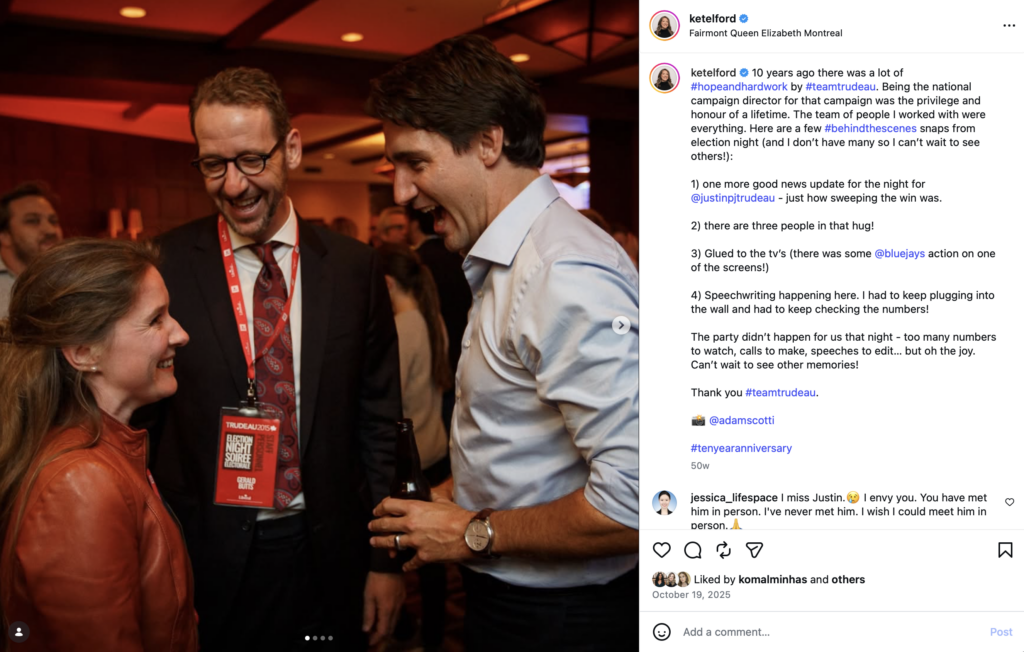
Jennifer Stewart: Okay, reflecting on the 10 years you were working with Justin Trudeau, was there a moment or an experience that changed you or moved you the most?
Katie Telford: Many. It’s always a tough one, and so it almost depends on when people catch me as to which, but I mean, that’s the wonderful thing of the job is, you know, I would do it all over again because I loved it. I think it’s one of the best jobs in the country, and I encourage everybody and anybody to get into it, whatever their political stripe.
And it’s how I got into it. It was people actually of other political stripes telling me, “Go get involved,” and how important it is to be involved.
I think politics is a great thing. It is what, you know, allows for our democracy to thrive, and so we all need to be engaged in it. Which means I was kind of doing the dream job in a lot of ways for a long time, and so I loved so much of it.
But I think the things that could end up being the most meaningful – there were obviously all the big moments, right? There’s going to a state dinner or meeting this person or meeting that person.
But it’s also the teacher that I actually connected with from Edmonton, Alberta, during the pandemic, who to this day is still engaged with me online. I’ve never met her in person, and she messaged me and just said, “Would there be any chance – he’s a teacher – could you get the PM to do a, you know, a virtual classroom hello?”
And we actually ended up arranging it, and then she did this long thread about it later, and talking about just how she never expected anybody to even see it, let alone for me to see it, even though she tagged me. So, of course, I saw it, but she didn’t know if we’d actually read our things.
And then for it all to have happened and telling the stories of the kids and their experience at what was a really difficult time.
I have, like, tons of stories of that, of people talking to us about, you know, getting a new benefit or when the national school food program rolled out. That was something I was particularly passionate about, or childcare, and when I started to see people posting the difference in their bills of what the deductions were meaning for them, you know.
Seeing those kinds of differences in people’s lives, I have so many individual stories like that. I think those are the things that kind of give you goosebumps.
Catherine Clark: Okay, we have some rapid-fire questions that we are going to ask you to answer. They are not too complicated. You can choose to skip them if you want. But first one is: Are you a morning person or are you a night owl?
Katie Telford: Night owl. Though I’ve been forced to become a morning person, both as a mother and in the job.
Jennifer Stewart: Necessary evil. The book that’s had the biggest impact on you.
Katie Telford: Book that has had the biggest impact on me. Oh, that’s interesting. So most recent, probably most impactful would be – and I highly recommend it. It’s not Angela Merkel’s biography. It’s actually one written about her called The Chancellor, and it’s excellent.
It’s an excellent book on just her whole story, right back to growing up in East Germany to going on to become chancellor, and her perspectives on so many issues.
And so, having, you know, in my case, having had the chance to meet her, but then read it, and I was actually able to read it in office, so it helped with thinking about things. But I think that’s the one that strikes me first.
I mean, in fiction, it’s Pride and Prejudice that I’ve gone back to many, many times over the years.
Catherine Clark: Katie, I love that your answers to things are as long as mine. It drives Jen nuts. Most underrated leadership trait from your perspective?
Katie Telford: Listening. How’s that?
Jennifer Stewart: What word describes Canadian politics today?
Katie Telford: One word, I think I would probably say complex.
Catherine Clark: You’re doing super well from Jen’s category of viewpoint right now with one-word answers. Okay, the best advice that you’ve ever received.
Katie Telford: I’ll give two pieces. One, and I received these a long, long, long time ago, but they were more pieces of management advice than anything. One was: keep your door open as much as you can. Not always possible, especially in the job I had most recently, but keep your door open as much as you can because it signals an openness.
And two is to make sure your team, not just your principal, knows you’ve got their back, and that it goes in both directions when you’re in that sort of chief of staff-like role. In order to make your principal best, your team needs to feel empowered, and they need to know you have their back as much as it goes the other way around.
Jennifer Stewart: Love that. Okay, last question: What’s something people would be surprised to learn about you?
Katie Telford: I mean, usually, it’s that I’m five feet tall!
Jennifer Stewart: I’m the opposite problem! It’s usually that I’m six feet tall.
Katie Telford: Yeah, yeah. It’s, um, it’s our heights are usually both for Justin and me, or what tend to throw people. But I’m shorter than people think, and he’s taller than people think.