Catherine Clark: When you were a little girl lacing up your skates for the first time, what did you imagine your future would look like? Is there anything about your life today that would have completely blown young Jayna’s mind?
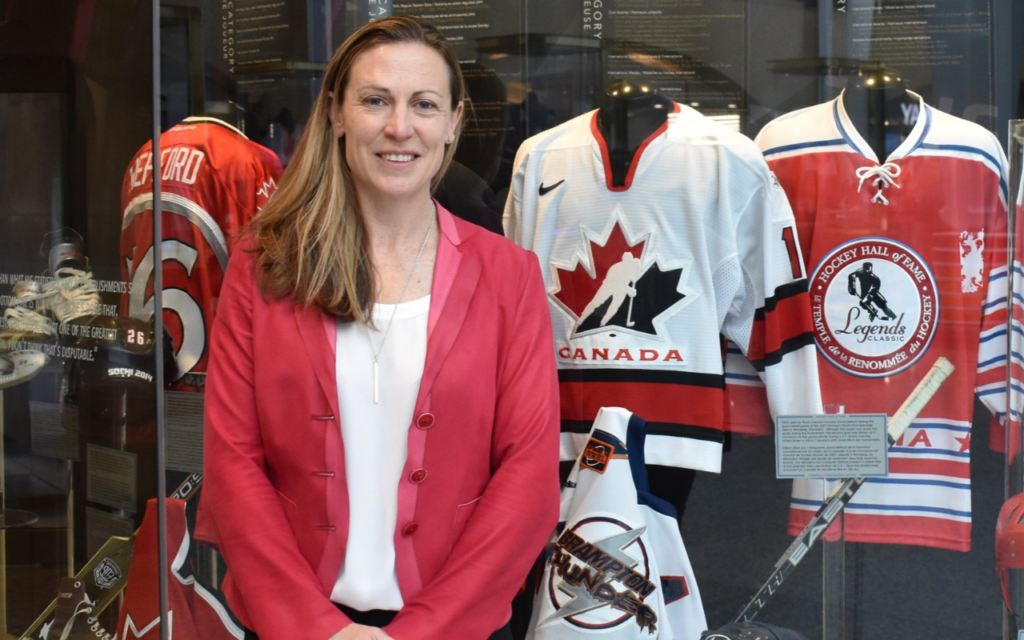
Jayna Hefford: I think a lot of where we are today would. I grew up in Kingston, Ontario. I have an older brother who played hockey. My parents were pretty involved in sport and coaching, and Hockey Night in Canada was a common thing in our house on Saturday nights. For as long as I can remember, I just loved playing the game, whether that was on the ice, playing road hockey with the neighbours or hotel hockey.
I had such a passion for it, and to me, it feels like it was just sort of innate because it started at such a young age. I dreamed of playing in the NHL. I dreamed of being the first woman to win the Stanley Cup, those sorts of things.
Thankfully, I had parents who were incredibly supportive and never told me that those things wouldn’t happen because I was a girl. They continued to encourage and foster that passion they could see I had.
When I started to play hockey, they actually signed me up for ringette the first time. I think they didn’t really know much different at that time. It was sort of like the girls played ringette and the boys played hockey, and I don’t think I realized I was going to play ringette.
After the first game, I said to them, “This isn’t hockey. It’s skating, but the rules of the game are very different.” It wasn’t that I didn’t like ringette; it was just that I always saw myself as someone who was playing hockey.
From that point on, they got me onto a house league boys’ team in Kingston, and I continued playing from there. The passion I had for the game is something that continues to drive me now, even in what I’m doing after my playing career.
Jennifer Stewart: Jayna, is there a moment when the sport became more than just a game? Do you remember the moment you actually fell in love with hockey?
Jayna Hefford: I don’t, but I think I’ve had that passion for so long. When you’re a young kid, you don’t think much beyond what makes you happy. I think it’s pretty simple at that age, and I’ve always felt so comfortable playing the game, being on the ice. Maybe, in many ways, it’s where I feel the most comfortable, or felt the most comfortable.
It just felt like the place I wanted to be. Then that passion continued to grow and, over time, grew into more of a motivation, drive and determination to achieve something in it. But at a young age, it was really just about what I loved to do and what made me happy.
Catherine Clark: I think it’s more normalized now that we have girls in hockey, obviously on boys’ teams, because a lot of the teams are dominated by boys. I know for my son, he’s had two girls who’ve played on his team in probably eight years of hockey. When you think back on that, and the fact that you were the girl in the locker room, what would your childhood teammates have said if they had to describe you in three words?
Jayna Hefford: I think they would have said I was competitive, probably quiet, and probably loved the game. The boys I played with were my best friends at the time, and there’s a handful of them that I’m still in contact with sporadically. Some of them went on to play professional hockey and do different things.
You hear a lot of really horrible stories about the one girl who was playing the game, and I’m sure there was a little bit of that outside noise. But my experience was actually positive. Maybe that was just the mindset I was in, but my teammates were my friends. I loved what I got to do. They accepted me. I was good at it, which helps. Generally, the experience was fairly positive.
Jennifer Stewart: Competitive sports take a lot of discipline for the child who’s playing, but they also typically require an adult or a champion who’s managing those early morning practices or driving to tournaments hours and hours away. Who was that champion for you, Jayna?
Jayna Hefford: Well, definitely my parents. I can say now as a parent that you have very little appreciation as a child for what your parents do for you. But looking back, I never missed a practice. I never missed a game. I can’t even remember a time when one of my mother or father wasn’t at my games or practices.
My mom helped coach and manage our team. My dad helped coach my brother’s team but was often there watching me as well. Having that support system is just so incredible.
Again, it was what I wanted to be doing all the time, and maybe not what they wanted to do all the time, but they were there every step of the way, supporting me through it.
Catherine Clark: If we fast-forward a little bit, you helped Canada win four straight Olympic gold medals, and you scored the winning goal at the 2002 Olympics. We know how the fans reacted, and we can imagine how your mom and dad reacted. But can you describe the atmosphere you would have encountered in the locker room for big games like that, some of the most important games of your career? What did those moments teach you about yourself and about being a member of a team, which has been such an important part of your life?
Jayna Hefford: Team sports, to me, are so critical, and I really try to encourage my kids. It doesn’t really matter what sport it is, but being in an environment where you learn to work with people, respect people, find commonalities and appreciate differences is important.
I always say that through sport, you learn these lessons, and you don’t realize you’re learning them, but it’s such a natural way to develop those characteristics.
For me, being part of so many different teams with so many different teammates and leaders, I’d like to think I try to take the best from each of them.
I was a player who always felt like I took a lot of pride in my consistency and showing up in a certain way every game, whether it was a gold medal game, a practice day or an exhibition game. I wanted my teammates and coaches to know what they were going to get from me. That’s something in my character and personality that people can rely on. They know what they’re going to get from me every time.
I work really hard. I’m disciplined. I’m competitive, as I said, and driven to achieve. I love to learn. I think that’s one thing over the course of my career: being willing to continue to learn, even when things are going well. Sometimes that’s the hardest time to keep an open mind.
Being willing to continue to evolve and reimagine and reinvent who you are is really important. I had a chance to play with so many great teammates and for so many great coaches who were great leaders, and I tried to take pieces of that and turn them into who I was.
I think who I am today is a result of all those experiences I had, specifically my experiences through sport.
Jennifer Stewart: You went from winning Olympic gold medals to helping build the professional league. Jayna, which role has challenged you more, elite athlete or executive, and why?
Jayna Hefford: I think being an executive has challenged me in ways I didn’t really know, and I’ve evolved so much over these last number of years.
On the ice, I don’t want to say it was easy, but that was where I felt the most comfortable. Having a natural passion, continuing to love the game and wanting to get better and being competitive felt so natural to me. Again, it wasn’t easy. There were definitely difficult times, and staying at the peak of your physical performance and your ability to perform in the highest-stress moments isn’t easy. But those are things that just felt more natural because I always saw myself as an athlete, as a hockey player.
Over these last number of years, from the time I retired, I went through some coaching with the University of Toronto. I worked at the PWHPA, which was an advisory player association where we were advocating for the creation of a pro league. Now, with the PWHL, I’ve been learning and working with people who come from different backgrounds, more of a business and leadership background, and trying to figure out how to have an impact off the ice the way I did on the ice.
I’ve faced a lot of challenges in that, but I’ve also taken so much pride in what has been created here. It’s very rare that you can build something and create something that doesn’t exist.
When I think about the proud moments in my career, there’s winning gold medals, which is the greatest honour, to be able to represent your country. Then I think about the impact of this league and women’s hockey on society and the societal changes it’s creating.
I have two daughters and a son, and they’re growing up in a world that’s much different from the world I grew up in. I know they’re going to be better in many ways as a result of that. I’m really proud of the way we’ve shifted that narrative and how impactful and meaningful that is for so many people.
Catherine Clark: It is a complete sea change because Jen’s and my moms grew up in a time when this just wasn’t a possibility. Maybe all three of us did. People didn’t even think of it as a possibility, frankly. Now here we are with a league, and it is going gangbusters. Was there a moment, Jayna, when you were standing off the rink and looking at what was happening in a packed arena and thinking, “Wow, I can’t believe this is really happening”?
Jayna Hefford: I’ve had many of those moments, and I get chills thinking about them even now.
Certainly, the first game of the PWHL, on January 1, 2024, at Mattamy Athletic Centre, when we dropped the puck for the first time. There were so many people on the outside who had said, “This can’t be done. It can’t be done this quickly. It can’t be done this well.”
There was that feeling of proving people wrong, but then, on the positive side, the building was packed. The joy, emotion and gratitude that were there made it a moment that so many of us, I don’t think, can even put into words or explain.
More recently, this past season, we sold out Madison Square Garden, the most iconic hockey arena in the world. To be able to put a regular-season game there and sell that building out was incredible.
We’ve had a chance to have these moments where you kind of wonder if you’re dreaming or think, “Can you pinch me?” But at the same time, we have such belief that this is an entertainment product people want to be a part of. It’s important and meaningful, and the hockey itself is incredible.
We have such belief in where this league can go, but we still have those moments where it really brings you back to how proud you are to have been a part of that, to be there in that moment and witness it.
Jennifer Stewart: Following up on that, Jayna, you’ve had so many accomplishments in your career. Has there been a specific moment with the PWHL when you felt the same level of excitement, or cried, as you did after a big win as a player?
Jayna Hefford: Yeah, I would say definitely that first game. Again, we spent a number of years advocating, building and trying to create something like this.
You don’t like to listen to the naysayers, but there are a lot of them. There are a lot of people who think you should be happy with what exists, just criticizing the way you’re trying to create change because change is hard for everyone. We get that.
When we see what’s happening in women’s sports right now, it is moving so fast. There are a lot of people at the front end of that who are just saying, “Let’s go, let’s keep it going.” And there are a lot of people who maybe struggle with the speed of what’s happening.
That moment was one I was so proud of, mostly because I think it was such a meaningful moment for so many people. I remember being in the arena and walking out to drop the puck, and there was a sign across the rink. It was really just saying thank you for bringing hockey to women, or whatever it was.
I get this a lot in rinks when I’m there, with people coming up to me and just saying thank you so much. And that’s it, because it really does mean something. There are women who never even got to lace up a pair of skates because it wasn’t accepted. There are young girls who could only follow their brothers around. Lots of people have felt excluded from hockey in general.
To be able to create an environment that gives people hope, inspiration and joy, that’s really the best part about what we do.
Catherine Clark: If you could permanently erase one outdated belief about women’s sports, what would it be, Jayna?
Jayna Hefford: Probably that it’s not as entertaining. A lot of people will say it’s not as fast or the players aren’t as big, and there are all those things. But if you can appreciate the sport for what it is, I love watching the NHL. I love watching women’s hockey. I’m a fan of hockey, and if you’re a fan of hockey, you can appreciate those differences.
In the women’s game, the way the women play, the strategy behind their game and the skill that’s incredibly visible based on the way we play all have something to offer.
It’s not that you have to pick one or the other. Real hockey fans see hockey for what it is. I think the biggest one is the belief that it’s just not as good because it’s women.
Jennifer Stewart: What’s a piece of advice you’ve received that seemed simple at the time but ended up shaping your career in a profound way?
Jayna Hefford: One piece of advice I got that was more timely, which made it more important, came from Billie Jean King. She said, “When you read history, it’s fast. When you live it, it’s slow.”
I remember her saying that at a time when we were trying to get the league off the ground again. There were a lot of naysayers. You have those days when you wonder if it’s even going to happen, if it’s going to work or if it’s even worth the effort.
Now you look at what we have, and in another 30 years, somebody’s going to read about the creation of the PWHL. They’re going to think, “Wow, it was a few years, and then they got a league going, and it was great.” But they’ll never know the journey, challenges and struggles that existed to get there, and that’s okay.
Those struggles and challenges are what made us what we are. They made us better and stronger, and they made the success more important.
Remembering that we all go through those tough moments is important. When you’re in them, they feel like they’re going to last forever. But when you get by them, they sort of just pass, and you come out on the other side.
Catherine Clark: Can we drill into that a little bit more, in terms of how you get through to the other side? A lot of women struggle with self-doubt, and a lot of women are in positions where they’re told that the idea they have or the thing they’re trying to accomplish is just impossible. In the moments when you question yourself, or when others were questioning you, how did you push through that?
Jayna Hefford: I think it was relying on my values and remembering what those were. I remember someone saying to me, in those tougher times, “If you can sleep well at night, then that’s all you need to know.” You’re doing something you believe in.
For me, at the time, it was that women can do this, and just because it doesn’t exist doesn’t mean it can’t exist. There’s value here, and people will want to watch women play professional hockey.
At the end of the day, I was fighting for something that I truly, down to my core, believed in. If you can rely on the values you have and surround yourself with people who hopefully share those values, you can uplift one another.