

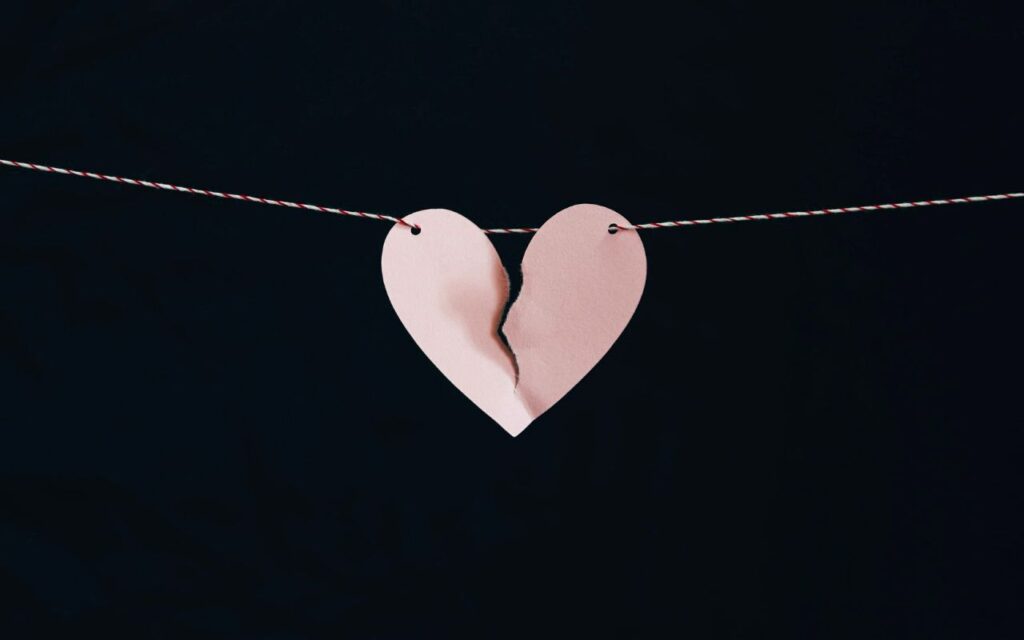
Breakups have their clichés – the playlist, the ice cream nights, the “closure” talk. But there’s another kind of heartbreak we rarely give space to: when a close friendship ends. For many women, that loss feels just as painful, sometimes even more so, than romantic breakups.
Yet societally, it’s treated as something to simply get over in silence.
“I cried for like three straight weeks,” says Sarah Burton,* recalling the end of a friendship that lasted over two decades. She describes it like “a Leslie*‑shaped hole in my heart,” that nothing will replace – a grief that surprised her in its intensity.
She’d been through a long-term romantic relationship ending before, but this felt different. Deeper. More destabilizing.
The deep emotional fallout
Burton describes a moment of clarity that came after being left out of a milestone she couldn’t ignore: her longtime friend Leslie’s wedding.
After those many years of friendship, Burton realized she hadn’t been included – and when she asked direct questions about why, she didn’t get answers. What ultimately ended the relationship wasn’t Leslie’s decision, but her refusal to engage. For Burton, that silence became the boundary.
Over time, her pain grew beyond disappointment, to shock, loss of identity and confusion all wrapped into one.
Personally, I can relate to all of those feelings. I lost one of my dearest friends, Jess,* during the COVID pandemic, when a gap in values and how that played out in showing up for each other was too wide to pass.
We talked it out a bit, but in the end couldn’t reconcile what I saw as my boundary being disrespected and Jess feeling unfairly treated. I still miss her to this day.
A safe space where we ‘show up fully’
Psychotherapist Parul Shah says these feelings are far more common than we tend to acknowledge.
Friendships, she explains, often function as places we can fully be ourselves, without the expectations or roles that come with family or romantic partnerships, as “A (safe) space where we’re able to share anything and everything.”
When that safety disappears – especially without closure – the emotional blow can be profound.
And it’s happening more than you might realize. Research shows that up to 70 per cent of close friendships end after about seven years, much of which is intentional.
Acknowledgment and accountability
Shah explains that friendships are closely tied to identity. “When we connect, we align, and when we align, we place our identity (on) that friendship,” she says. So when the bond ends, it can feel like losing more than a person. “It’s a death,” she adds. “There’s a little stigma around friendship loss because it’s a grieving process.”
That stigma shaped how Burton experienced the aftermath. The unanswered questions made it harder to move on. She wanted to understand her place in Leslie’s life and whether it had changed, but the lack of response left her carrying the emotional weight alone.
Shah says this is where many people get stuck. “We keep going … and then we’re more confused,” she explains, describing how rumination can take over when there’s no acknowledgment or accountability from the other person.
Setting a clear boundary for ’emotional safety’
Eventually, Burton made the decision to step back – not because she needed a particular explanation, but because continuing without honesty or communication was becoming harmful. Her boundary was about self-preservation.
Shah notes that boundaries in friendships are often misunderstood. They’re not about cutting people off impulsively, but about recognizing when a relationship no longer allows for mutual care or emotional safety.
We move on, but the care sticks
As for me, I was lucky enough to have answers. My story was more a case of feelings and views so disparate and strong that there was no longer common ground between Jess and me. An incredibly sad reality, but one I had to accept nonetheless.
Now, nearly a year later, Burton still worries about Leslie and thinks of her each day. While the grief hasn’t disappeared, “Every day gets a bit better,” she acknowledges. The impact has changed and no longer dominates her life in the same way.
“When you care for each other as friends, (you) owe each other care and dignity and clarity,” Burton adds. Although she didn’t get what she needed, she also feels, “When a friendship ends, I don’t think the care ends.”
I couldn’t agree more.
* Names have been changed to protect identities.


Emma Caplan-Fisher