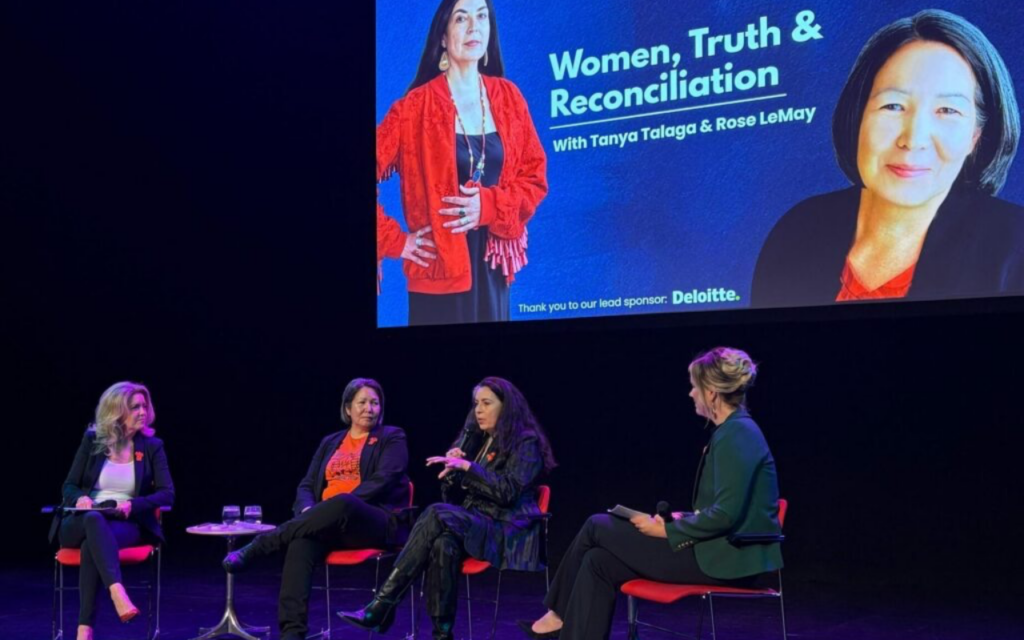
Jennifer Stewart: So Tanya, I’m going to start with you, and it’s a blunt question: How is reconciliation actually going from your perspective?
Tanya Talaga: Miigwech, it’s really good to see all of you here tonight. So many orange shirts. That’s really heartful. It’s lovely to see!
Okay, so true story. When I started as an Indigenous issues columnist at the Toronto Star, I think my first column was Reconciliation Is Dead. This was years ago, I think it might have been 2017, a couple of years after the TRC reported in 2015 with the 94 Calls to Action, and I was feeling pretty low.
I had just finished writing a book about children in northern Ontario, high school students who did not have high schools to go to in their home communities, so they had to leave their parents, their language and everything they knew, and go to high school in Thunder Bay. Those seven students passed away in Thunder Bay, and so that book is Seven Fallen Feathers.
I was really wrestling with the fact that we live in a country where we don’t have high schools for our kids. How is it that we live in a country where we don’t have basic healthcare for our people? Why is there such a difference?
Then the TRC came out with 94 Calls to Action, and fast forward to 2026, and I think we’ve got 14 of the calls done. A lot of those calls are low-hanging fruit, and while they’re still important, they are not the heart of the issue.
I promise to stop talking soon, but the first few of the TRC Calls to Action have to deal with child welfare and education. Those were done on purpose by the survivors. There were 7,000 witnesses and survivors of the schools. They put those first because those were the most important to them. They never wanted to see this happen again, and that is why that happened.
Yet those are the calls that are the toughest to crack, so we are still working on it. When I can say I don’t have to write another book about kids having no high school, having no clean water, being sent out, and our children being 14 times more likely to be in foster care than non-Indigenous kids, when that is over, then I can say that reconciliation is happening.
Catherine Clark: So I think a lot of us, Rose, this week were shocked and taken aback and horrified at the news out of Kamloops. There were protesters who, for those who didn’t know, were basically denialists. I’m wondering how you feel when you see that, but also what you think, given that we have achieved so few of the Calls to Action, some of us in this room and some of us outside in the broader community may not understand about reconciliation.
Rose LeMay: How do I feel? Michelle, my wife, would tell you that I spent half the day crying after that. I don’t know what else one should feel. I think we all felt something, from horror to outrage to fear that this could go on in our country at Kamloops. It’s so horrific.
I call them tin men. They just have no heart.
What does it mean, though, when this is going on? White supremacy is actually risking the lives of Indigenous peoples. Yes, it is.
When we’re trying to do reconciliation, I think it means that we need to set our standards higher. There is a thing that happens in the city of governments where we try for the low-hanging fruit. We try for the things that we can measure. We attempt policy shifts on the first steps, not planning for the big steps, and that has truly held us back.
For those of you who work in the federal government, swing high, swing hard. We’re done with the easy. We’re done with the stuff we can measure. What we really need is significant system shift, and maybe that’s the discussion we need to have.
Changing systems, yes. Challenge racism every single time you see it, but change the systems, from corrections and the overrepresentation of Indigenous peoples in our jails. They’re not all criminals. From child welfare, they’re not all poorly parented, not even close. To education, not having the schools that your kids in the city deserve. So do all of our kids.
Those are huge systems to change. But there’s one thing I know that people in Ottawa know: you know somebody who makes the decisions. You probably share a fence with somebody at an ADM level or higher. Those are the important discussions to have to start shifting this yardstick from easy to the things that truly matter.
Jennifer Stewart: Thanks, Rose. Tanya, in your opinion, Indigenous women face higher rates of violence and disappearance, despite years of talks about reconciliation and efforts. What are we still getting wrong, and how do we fix it? That’s a simple question with a deep, deep thing to unpack, but where do we start?
Tanya Talaga: That is such a hard question to answer, but widespread systemic change needs to happen.
Indigenous women are the most vulnerable of the vulnerable, and why is that? You have to look at Canada’s history in order to fully understand that question. When I say that an overhaul needs to happen, I really do believe that to be true.
I believe our histories need to be taught in elementary school, in public school, in high schools, and the truth of what happened in this country, how it was settled, about the Indian Act, about Indian residential schools, about what happened. Every Indian residential school had a graveyard. That’s true.
I think we have to change people’s perceptions and minds and know who we are as women.
There’s a second part to that, too. We had a National Inquiry into Missing and Murdered Indigenous Women and Girls. I was a witness at the inquiry, and I was there when the inquiry started. I was there when the inquiry ended. Where are those recommendations? Where are those Calls for Justice? They are nowhere.
I cannot believe that. It’s hard reading, yes, but it’s essential reading. Justice Marion Buller and all of the commissioners laid it out. The roadmap is there, between the TRC Calls to Action and the National Inquiry Calls for Justice. We know what to do. We need to start on that path in order to make those changes.
Jennifer Stewart: So, what’s wrong? Why are we not following that roadmap?
Tanya Talaga: Well, there are a lot of things wrong. I think moral will takes a lot of it.
We, as people, everybody in this room, have to want to make a change. It can’t be like, “Oh yeah, that sounds like a really good idea. I’m so supportive of the inquiry,” and then forget about it and not talk about it again.
You have to do things like vote. You have to know who you’re voting for. You have to ask your candidates questions. Do you know about the inquiry? What are you doing about these Calls for Justice or the Calls to Action? Ask them questions. Don’t let them get away with things, because we do that, right? We just let things slide.
I think it was Cindy Blackstock who said, “This country has a willful blindness when it comes to Indigenous people,” and that has been the history for a long time.
Why? Because none of this was taught to almost everybody in this room, except for the littles who are growing up now, right?
So it’s change. It’s widespread change to me, and every person has a role to play in that.
Catherine Clark: Tanya, I want to pick up on that. Rose, I’m going to ask you this because you actually have a book called Ally as a Verb. I also want to make it very clear that I’m pretty sure most of you walked by the stand with all of the books as you were coming in here, and we’re doing a book signing after, so that these wonderful women can sign copies of their books.
But allyship, one of the things that makes movements successful is when people realize that it’s not just the people who are campaigning for change for themselves who are responsible for this. It’s actually all of us working together.
So what do we need to know about how to truly be good allies and to teach our children, our friends and our family members to be good allies, too?
Rose LeMay: For those of you who’ve already purchased my book, thank you. You might have got to the point where I was talking about my Aunt Ariel, who is an ally. She used to work in the Downtown Eastside, which is frontline work supporting those who are housing-challenged and have mental health challenges.
One thing that she said a long time ago to me that stuck with me is that if, as parents, we don’t advocate for those who don’t have what we have, neither will our kids.
It really stuck with me, the role that we play in parenting and the role that we play as influencers, even in our networks. If we don’t do it, it literally won’t happen.
But there’s another thing I want to touch on, around knowing history. I know that you’ve spoken about it. We’ll keep on coming back to it. But literally, the more that you know of history, the more urgent the need for reconciliation. I can’t stress this enough. The more that you know about history, the more urgent and critical the need for reconciliation.
People in your network who don’t believe in reconciliation probably also don’t know history. It’s so important. It’s so important for the lives, literally the lives of our Indigenous kids at this point.
But it’s also important, if I can jump all the way to Google Satellite View for a minute, for our democracy. And you think, “Wow, Rose, how could you make that jump?” Just wait. I’m going to make this jump.
If those of us who are most at risk are Indigenous women, First Nations women, we’re at risk of being missing and murdered. We’re at risk of getting shot by the police. We’re at risk of racism in hospitals. We’re at risk of, name it, probably an Indigenous woman in this very room could tell you an experience that would horrify you.
When some of us are left behind, none of us are doing well. And when we look down to the south and to the States…
Here’s the lesson that we have as people who care about a democracy, which is ours.
The moment that DEI went under, within months, I have known of DEI practitioners in the States who have died. When a democracy stops protecting those who are most at risk in the States, it’s Black Americans, it’s those who are LGBTQ. It doesn’t take very long. At most, a couple of years, and then we lose it all.
Democracy rests. Our democracy rests on our ability in the next five years to do reconciliation so well that the rest of the world looks at us and says, “Okay, we can follow that model.”
But that requires us to know history. That requires us to recognize the wrongs, the genocide, and be able to say out loud, “This is what we as a country did,” because only then can we move on.
It’s a hard story, for sure. It’s a really hard story.
Jennifer Stewart: Tanya, you spoke to the fact that our children are now learning Indigenous history in the classroom, but so many of us didn’t. It’s on us as individuals to seek out that information.
How do we bring that information forward so that we can educate the masses and drive reconciliation forward? What are the tools and tactics that we can start deploying?
Tanya Talaga: I’m such a huge believer, and I talk about this all the time. Education reform. Education reform is the way to go in this country.
Changing the curriculum and making sure the curriculum actually is changed, and not something that can be removed or altered from one government to the next, because we see a patchwork all across this country of things that are taught in the curriculum and then they’re pulled out, or the brakes get put on. That does everyone’s children a disservice.
That starts white supremacy. That starts all of the problems.
When the kids are small, they get it right, and we should have curriculum right across the board that talks about Indigenous people, that talks about the Indian Act, that talks about even just localizing it. Talk about the nation that your school is on. Find out who the people are. Find out their history. Bring in elders. Bring them into the schools.
The world will open up. It’s not just history, like Canadian history. It’s cooking. It’s music. It’s sports. It’s everything. Broaden your horizons, and that is how we bring change.
I’ve always said it’s education reform, and Senator Sinclair said the same thing. Well, he said it first, actually: “Education got us into this mess; it’ll lead us out.”
This is an edited transcript. Listen to the full episode to hear the full conversation!