
Have you ever wondered what happens to the clothes you return? The ones you package up and throw in the mailbox? What about the items that don’t sell?
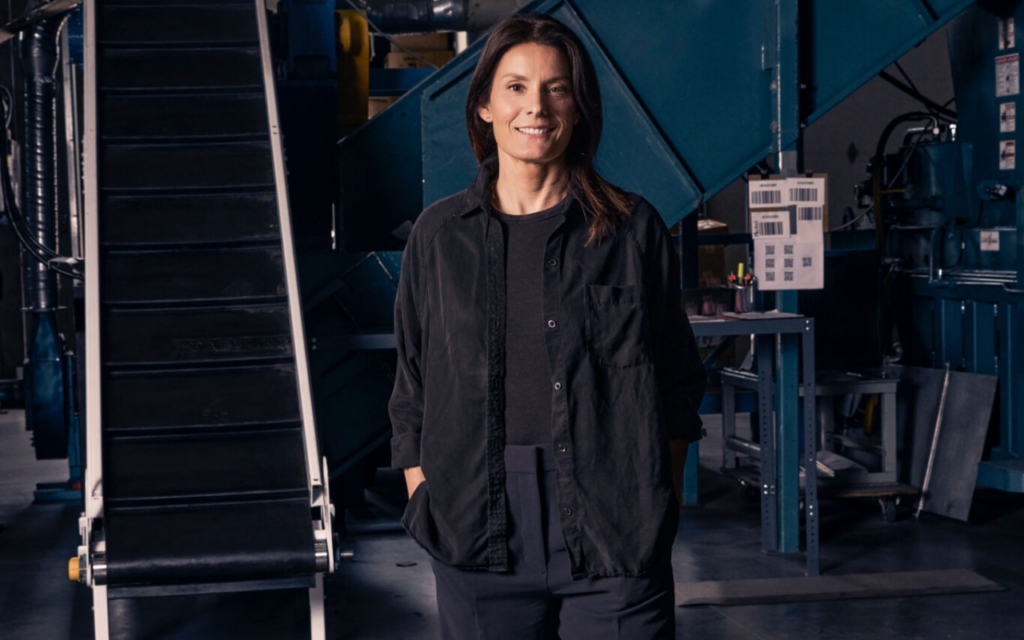
Amelia Eleiter has spent nearly two decades thinking about exactly that.
After working for a few years with a marketing agency post-grad, she found herself on the beaches of Sri Lanka, volunteering for an NGO and thinking about what she was going to do next. That was when an idea hit her – or rather, wrapped around her.
“My friend Wes said, ‘Hey, Amelia, there’s something on your leg,’ and I thought it was seaweed. Turns out it was a wrapper from a pop bottle,” she said. “Here we were in this very untouched part of Sri Lanka, clear water, white sand, no commercialization, and there’s branded waste floating around the ocean.”
That was the moment Eleiter and her friend and future business partner, Wes Baker, started thinking about what happens to the products businesses put into the world once they’re finished with them.
Their original idea was focused on branded materials created for marketing campaigns: they wanted to take the assets back, remove the branding and find a way to reuse or recycle the materials.
It was a starting point, but the question behind it was bigger: what happens to a product when a brand no longer has a use for it?
On a beach more than 10,000 km from Eleiter’s home in Vancouver, Debrand was born.
Giving clothing a second life
When they returned to Vancouver, Debrand initially worked with companies on recycling everything from temporary marketing installations to promotional products. But it wasn’t until Lululemon came to them with a warehouse full of returned clothing that they found their next focus.
Wanting to avoid the landfill, Lululemon was looking for a more sustainable way to dispose of the items, like recycling.
However, much of what was being called textile recycling at the time was actually resale, often into overseas markets, with little transparency about where those products ultimately ended up, explained Eleiter.
Debrand had an opportunity to fill that gap by finding trusted recycling partners and doing the legwork.
Today, the company has become a kind of triage point for the fashion industry. Apparel brands send Eleiter’s team their excess, returned or damaged products, and Debrand identifies what an item is, what condition it’s in and what it’s made of, then matches it with a potential next use. That could mean reselling it, reusing the material for something else, or recycling it, depending on the product’s condition.
“There’s a misconception that this should be something that brands offer and do themselves, but it’s not that easy,” said Eleiter, adding that her team tackles everything from sorting products to removing buttons and zippers that can’t be recycled. “It does really take a system to do it.”
In 2025, Debrand diverted over 2.5 million pounds of textile waste from landfills, recycling over 70 per cent of the products they received. They are also committed to helping create a more transparent textile industry by sharing the life cycle of each product.

“Everything that comes in is traced and tracked, and the client knows exactly where it ends up,” said Eleiter. “That is an area that I want to have an impact on, not only as a leader at Debrand, but within the industry as a whole.”
The bigger picture
If there’s one thing Eleiter wants people to understand, it’s that this isn’t simply a story about recycling.
The fashion industry has become incredibly efficient at producing, distributing and selling clothing. That has also changed our buying habits. The rise of e-commerce has put products just a click away, and has some brands seeing exponential increases in the rate of returns.
“Reverse logistics, or getting product back to the manufacturers, was not a thing when we started,” she said. “It’s really become something that has been required because of the way that we shop.”
And it’s a problem happening at a massive scale. Clothing and textiles are already one of the fastest-growing waste streams globally, with 92 million tons ending up burned or in landfills each year. As consumption continues to rise, Eleiter says the industry needs to figure out how to use those materials more wisely.
That means building better systems to collect, sort and determine what should happen to products once they’re no longer wanted.
Right now, much of the infrastructure needed to do that is still in its infancy. Closed-loop textile recycling, where old clothing can ultimately become new textiles, remains limited. There are also difficult questions around the economics and demand for recycled materials.
It’s why Eleiter sees Debrand’s role as part of a much larger shift.
She describes it as “birthing an industry” – a systemic change that will require brands, consumers, recyclers, technology companies and regulators to all play a role.
And that change is beginning to take shape. In July, the European Union banned large companies from destroying or burning unsold clothing and shoes, while other regulations are beginning to push brands to take greater responsibility for what happens to products at the end of their first use.
For Eleiter, the opportunity is to make sure the infrastructure exists to support that shift.
“We need to make sure that regulation is set up properly to make our system better and more resilient,” she said. “But I think the commitment to innovating, from material innovation to business model innovation to leveraging systems and software to really unlock potential is exciting to me.”
For Debrand, that means staying focused on the piece of the puzzle it knows best: identifying and sorting products and getting them ready for whatever comes next.
Eleiter will be the first to tell you there is still plenty to solve. But after nearly two decades, she believes the industry is finally at a tipping point – with technology, regulation and growing consumer awareness creating the conditions for change.
“We have this great opportunity to make a difference, and that’s what gets us out of bed in the morning,” she added.

Lisa Thibodeau