
Maybe this is shameful to admit, but I go through some pretty significant reading ruts.
I love reading, don’t get me wrong, but I can go months without picking up a book. It’s not until I stumble across something that has me staying up far too late, turning pages, that the spark comes back. This month, I found that book.
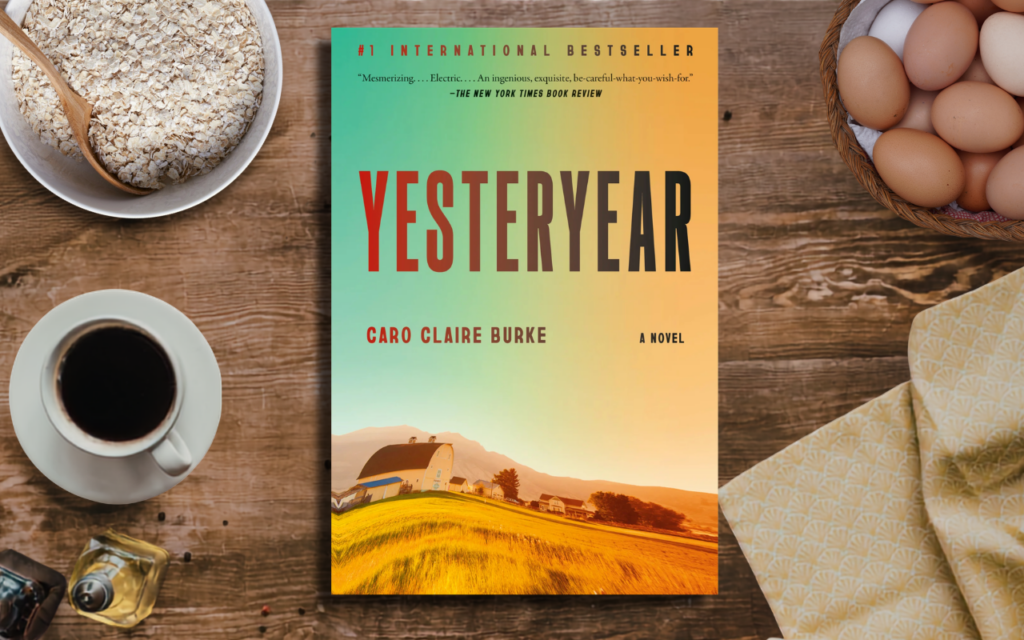
I recently picked up Yesteryear by Caro Claire Burke because the premise sounded interesting (and yes, it was all over my Instagram FYP): a tradwife influencer gets transported back to the 1800s and is forced to live the kind of life she spends her days romanticizing online.
Alright, you’ve got my attention.
As someone who has always been fascinated by tradwife influencer culture – and admittedly a little horrified by it – I was immediately sold. Do these women really want to live a life of domesticity? Of traditional gender roles and controlled femininity?
Let’s find out!
The writing in Yesteryear is clear and easy to follow, the story hooks you almost immediately, and while I disagreed with most of the characters’ views, that was part of what made it so compelling.
The book follows Natalie, a social media tradwife who isn’t particularly likeable. In fact, there were long stretches where I found her frustrating, self-serving, and completely disconnected from reality.
In truth, I would place myself at the opposite end of the spectrum from Natalie. I’m not a mother, I value my independence, and I’ve never felt particularly drawn to traditional ideas of womanhood. (Natalie would probably categorize me as an “angry woman,” and honestly, I’m fine with that.)
Still, in a world that feels increasingly polarized, where we’ve become less interested in understanding one another and more interested in proving each other wrong, I found it fascinating to spend time inside her worldview. Even when I disagreed with her conclusions, I was interested in how she thought about gender roles, motherhood, religion, and politics.
But what I came away with was that Yesteryear isn’t really about traditional values at all. It’s a story about performance.
What Burke does so well is present the hypocrisy of tradwife influencers. Natalie is constantly reshaping events to fit the story she wants to tell herself about who she is. She has built an entire identity around being a tradwife. Still, underneath it all, you never get the sense that she believes in the life she’s selling. She believes in the image of it. The aesthetics of it. What it allows her to project to other people.
But who is she when no one’s watching?
She wants a husband who leads, yet she’s the one making decisions. She wants motherhood to feel natural and fulfilling, yet her experience is often uncomfortable and filled with deep resentment. She wants certainty through religion and politics, yet spends much of the novel wrestling with thoughts and feelings that don’t fit neatly into the identity she’s created.
Despite all of that, she continues to live this curated life that presents all those ideas as fact.
I’ve seen some readers criticize the book for not feeling believable because Natalie never seems fully committed to the lifestyle, or for the ending being a quick plot pivot rather than diving deeper into the real world of modern womanhood and Christian conservatism.
To me, that’s the whole point of the story.
It was never going to be about the inner workings of tradwife culture because for Natalie, that was never real. The book also isn’t asking whether traditional values are good or bad. It’s exploring the gap between a life and the performance of a life.
In that sense, the book feels more relevant than ever. It’s easy to read Natalie as a commentary on influencer culture. But, she’s also a reminder of how many of us curate versions of ourselves, online and offline, that don’t fully align with who we are.
And that’s why the ending worked so well for me.
Without spoiling anything, it felt like the only ending the story could have had. It takes the book’s central idea – that you can construct a version of yourself so thoroughly that it begins to feel real – and follows it to its natural conclusion. The story remains rooted in Natalie’s reality, which I thought was incredibly smart.
Now, is the book perfect? No. There were definitely moments when I questioned the logic or wished certain plot points had been explored more deeply. (And I did have to read the ending twice to put all the pieces together.)
But I didn’t really care.
The ideas at the centre of Yesteryear were interesting enough that I was willing to follow the book wherever it wanted to take me. And if a novel can pull me out of a months-long reading slump, that’s probably the highest compliment I can give it.


Lisa Thibodeau