
Jennifer Stewart: I want to start with the elephant in the room. I can’t open up Instagram, or frankly, go have conversations with friends and not hear about GLP-1s. What exactly are they, and how did they become so closely tied to our weight loss conversations?
Dr. Sasha High: Yeah, so I mean, this is kind of the new era of obesity treatment. GLP-1 stands for glucagon-like peptide. They are peptides that our body already naturally produces, so all of us make GLP-1 in our small intestine.
That molecule, the GLP-1, does a number of functions in the body. One, it acts on the pancreas to stimulate insulin secretion to bring blood sugar levels down after a meal. That’s where it was discovered that these medications are very helpful in treating type 2 diabetes to lower blood sugar.

But they also act on the brain, and the peptide acts as a satiety signal for the brain. It kind of gives your brain a message: “Hey, you’ve had food, you’ve had enough, you don’t need to take any more in. You can shut off appetite.” So it increases satiety.
With the discovery of these medications, it’s really revolutionized obesity treatment over the last 20-ish years. We’ve had these medications in diabetes and then in obesity since 2014, and it’s made it possible now for people living with obesity to actually keep the weight off.
Because as most people know, it’s very, very difficult to lose weight and keep it off over the long term, particularly if you have a lot of weight to lose, because the body’s defense against weight loss kicks in. There’s something called metabolic adaptation that makes it very difficult.
The medications help to counteract that metabolic adaptation and help people be able to keep the weight off. But not only that, they also improve cardiovascular health and the cardiovascular risk that can come along with excess adiposity. They help with blood pressure, lipid lowering, blood sugar lowering, fatty liver, and reduce the risk of cardiac events in people who are high risk.
So these are cardio-metabolic medications even more than they are weight loss medications.
Catherine Clark: Okay, so I think out of that, Jen and I probably have 100 more questions. I’m going to ask one that just jumped out at me from what you said, which is: the body fights against weight loss. What does that actually mean?
Dr. Sasha High: I think this is the part that a lot of people don’t understand, because people think it’s just willpower. It’s just, “Do your calorie counting, move your body, you should be able to do this,” without realizing that from an ancient perspective, if we look at human beings as ancient beings, we were kind of made to hold on to fat as storage of energy for times when energy was scarce.
So for times when there might be a famine and we needed to have energy stored on board, the body does not like when we lose weight. That is alarm bells for our brain.
The brain doesn’t know that you have too much energy on board. It just sees when energy is going down. There’s a hormone called leptin that is in proportion to how much body fat you have.
The brain looks at leptin levels, and if leptin levels start to drop because you’re losing weight – so if you lose fat mass, you lose leptin levels – your brain sees that as an alarm signal and sees it as very bad.
It sees it as, “Oh my goodness, you could be dying. You could be starving to death. Let’s conserve as much as possible. Let’s slow down the metabolic rate. Let’s get you seeking food.”
So it gets you thinking about food more, having more food cravings, and getting out of your chair to go and get food.
That was beneficial at times where we needed that motivation to get out and forage for berries, forage for food, or go hunt an animal in a hunter-gatherer type of population. That was a helpful thing to have.
But we live now in a modern food environment where there is no food scarcity. Food is abundant, food is everywhere. Food is also designed to override all of the pleasure centers of our brain, right? So we overconsume.
But we still have a very ancient brain that is still perceiving any loss of fat on the body as something potentially very bad.
So the two major things that happen are it slows your metabolic rate down and increases your preoccupation with food – your thoughts about food and cravings – and all of that is really favouring weight regain.
That’s the simplistic view. There are a few more complicated pieces to it, but essentially, if you ask most people, that’s their lived experience, right? Most people will say it’s easy to lose the weight, very hard to keep the weight off.
Well, it’s not just willpower. It’s actually a biological mechanism that causes that.
Jennifer Stewart: A lot of people don’t know that GLP-1s have been around for decades to treat diabetes. A lot of people think they’re new on the scene, and there are a lot of conversations about whether they’re safe. What’s the answer to that question?
Dr. Sasha High: I think it’s really important that we ask ourselves that question with any medication, right? With anything, there are always going to be risks and benefits with any sort of intervention.
But we do have quite a bit of data. These medications have been around for about 20 years, and probably about 10 years prior to that they were in research, because it takes a while for a medication to actually get to market.
So we have a couple decades at least of data to this point, and we are pretty aware of what the potential side effects are.
I think the conversation always needs to be balanced by: what are the risks of not treating?
There can be side effects with medications, and we can talk about those, but there are very real risks to untreated obesity and all of the cardio-metabolic risks that we know about.
If someone’s BMI is over 40, their life expectancy is reduced by a decade – 10 years of life lost. There’s increased cancer risk, breast cancer, endometrial cancer, a fourfold increased risk with obesity.
And it’s not to paint a scary picture, but it is to say we have to have a balanced conversation: risks and benefits of untreated obesity, and risks and benefits of treatment.
That also brings in: if you don’t have the risks – meaning you’re using these medications for aesthetic purposes, Hollywood, all of that – then maybe the risks don’t outweigh the benefits.
So I think it’s a really important conversation that patients have with their physician to look at it all, because it is very nuanced.
Catherine Clark: Can you give us a snapshot, if possible, of who would actually be a good candidate for GLP-1 medication, and are there people who should avoid it?
Dr. Sasha High: I think the good candidate is a person living with obesity or type 2 diabetes – those are the indications, right? Those are the indications: if you have type 2 diabetes, if you have obesity, then we’re looking at other conditions where Health Canada hasn’t necessarily approved them, but they have approvals in the United States.
Obstructive sleep apnea would be an example. We’re also looking at having this medication for fatty liver disease, or metabolic-associated fatty liver disease, as it’s now called.
So for people who have excess adiposity that’s causing an impairment to their health – that’s the definition of obesity – they may be potential candidates for the medication if they don’t have contraindications.
Who is not a good candidate? The person who is using it as their quick fix, or, “I just want to lose five pounds for the summer to fit into my bathing suit,” or the fitness aesthetic, the bodybuilders, the endurance runners, who are using these completely off-label to try to fit other needs.
I think I would be very cautious there because they have not been studied in that population. They’ve not been studied in people of normal body weight who are using it for other reasons other than the treatment of metabolic disease.
Jennifer Stewart: What are the biggest physical and emotional changes women should realistically expect when they start using a GLP-1?
Dr. Sasha High: Yeah, that’s a good question. I think the very commonly biggest change that people experience early on is what is described online as “food chatter.”
A lot of people with obesity – because the brain is what drives the excessive food noise, that desire to seek out food that is in excess of what is actually needed for the body – it’s actually happening on a central nervous system level.
There’s a lot of food chatter, so that means a lot of preoccupation with food, a lot of mental real estate taken up by, “When did I last eat? When am I eating next? What’s my snack going to be?”
And that’s quieted.
A lot of people don’t realize that this is biology that’s driving that. They just think it’s them, right? And there’s a lot of internalized blame for people who haven’t yet experienced what happens with the GLP-1.
Then they start treatment and they come back, and they’ll tell me, “I cannot believe that it wasn’t just me. I understand now that this was the biology driving it.”
All of a sudden, I’m not thinking about food all the time. I have room in my brain to think about other things. I feel so free, right?
Because otherwise, it’s something that has caused a lot of preoccupation – whether it’s food, weight, or their body – for many, many decades for many people.
So early on, there’s that quieting of the food noise, a reduction in cravings, and increased satiety.
Then over time, as people start to see the physical changes as well, they start noticing benefits in terms of quality of life.
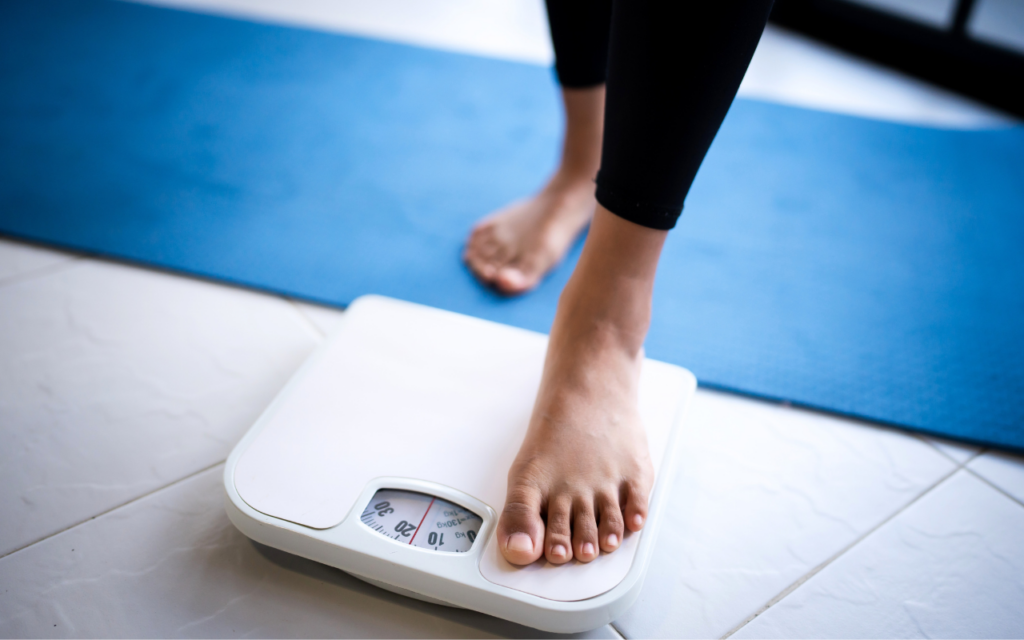
It’s never just about the scale, right? It’s never just, “Oh, amazing, I’m down 20 pounds.”
Ultimately, what does that do for you? How does that improve your life to have lost that 20 pounds?
Can you go for that hike that you really wanted to be able to do? Can you run around with your grandkids more easily? Can you reach down and tie your shoes?
People will say, “I can do that now, and it’s not uncomfortable for me.” My pants aren’t uncomfortable. I can get on the plane and not need the seatbelt extender.
So it’s always about the quality-of-life improvements and the health improvements. We see their blood work improving.
Those are the things that we really celebrate.
The scale going down is just part of the whole picture, but it’s usually not the final outcome that is the most exciting for people.
Catherine Clark: Dr. High, one of the things that really surprised me and truly got me thinking about these medications was I talked to a close acquaintance who had noticeably lost some weight and admitted to me – or shared with me – that it was because of GLP-1 medications. She said, “I hadn’t really laughed in a year, and when I went on these medications and I lost weight, I felt so much more confident in myself, so much happier in the life that I was living, that I noticed I started to laugh again.”
I was absolutely startled by that revelation about the actual mental health change it had provoked in her life as well. But I balance that with also hearing from other women who say, “I have low-level nausea all the time.” So what are some of the positive and negative side effects that people are experiencing?
Dr. Sasha High: Yeah, so the most common side effects are the GI side effects – gastrointestinal side effects – that you kind of alluded to, where there can be a degree of reflux, nausea, constipation, diarrhea.
Those are the ones that I usually counsel patients about.
This should be limited to the early stages of treatment, during what we call the titration phase, because the medication is slowly introduced at a low level, and then the doses increase to allow the body to get used to it.
For most people, this should be mild. This should not be something that’s really interfering with their life.
There are some people who are very sensitive, but it should be mild. And there are so many things that we can do to alleviate those side effects by either going slower with the dose titration.
Making nutrition changes makes a huge difference as well. There are a lot of lifestyle changes that will help with that.
I think my counsel, if there’s anyone listening who is having a lot of side effects, is you may want to speak to an obesity specialist if you aren’t already, or just someone who is very familiar with these medications.
Where I see people running into trouble – where they’re vomiting every day or having very extreme side effects – they’ll come to me and say, “I will never go on those medications.”
And if I dig a little deeper, it’s usually because it was a provider who wasn’t as familiar with the medications and didn’t necessarily know how to counsel properly on dose adjustments, side effects, and how to manage all of that.
For the majority of people, it should be very mild, and it should go away after the first three to five months.
So if you’re hearing from friends like, “Oh no, it’s all the time,” there’s something not right. That’s not how these medications work.
And I think that’s also a misconception: some people think, “Oh, it’s because I’m nauseous, so I’m not eating as much, so that’s how it works. I better tough it out because the nausea is going to make me lose weight.”
Actually, that’s not at all the mechanism of action of these medications.
If that’s the experience, that’s not correct.
People can feel well, and that’s what I want for my patients. I want you to feel better. The whole goal is to get you healthier, not feeling worse.
So I think a little bit of counselling there can be really helpful.
Those will be the most common side effects, I think.
Jennifer Stewart: Dr. High, how do hormones, perimenopause, insulin resistance – how do they affect how women respond when they’re on these medications?
Dr. Sasha High: Yeah, that’s a good question.
So we know that with the menopause transition, one of the things that happens with women is they do develop an increased level of insulin resistance. And insulin resistance is already quite common in people who have obesity.
The hormonal changes of menopause, mainly the dropping levels of estrogen, don’t actually cause weight gain, and that’s pretty well established.
It’s more the aging and the changing lifestyle, when we tease out all the different factors for women, that causes the weight gain.
What the dropping estrogen does do, though, is cause a change in body composition, where there’s more central adiposity.
So instead of weight going to the hips and the thighs, and you kind of get a bit curvy, now you’re getting it in the midsection. Women will describe it as, “I’ve got this belly fat, I’ve got a tire. I haven’t had that before.”
And that’s associated with cardio-metabolic risk.
GLP-1 medications can be a very good option for women who have maybe had challenges with their weight all this time, and then get tipped over into having more risk because they’re going through the menopause transition, finding it harder to manage their weight, and having more weight around the midsection.
Because then they’re now developing the cardio-metabolic risk, and that would be an indication for considering GLP-1 therapy.
Catherine Clark: Can you just define adiposity for me?
Dr. Sasha High: Oh yes. Adiposity means fat – fat tissue, essentially the fat tissue on your body.
Catherine Clark: Speaking of the reverse of that is muscle mass. There are lots of conversations online about becoming too thin and losing muscle mass. What should women know about how to maintain their strength, and also the nutrition you’ve mentioned a couple of times, while taking GLP-1s?
Dr. Sasha High: I’m so happy that this is part of the conversation because more people need to be talking about this.
We will all lose muscle with aging. As soon as we turn 30, we’re losing a little bit of muscle, and when you turn 60, that gets accelerated.
So all of us women should be strength training and making sure that we are prioritizing protein as part of our balanced meals.
How much protein? A good target is 1.2 to 1.6 grams per kilogram of body weight.
But if you want to really simplify it, then if you just target 30 grams per meal and 15 grams with a snack, you’re going to get somewhere into the 100 to 120 range, and that’s a good starting point.
So for people who don’t want to do math and don’t want to calculate it, it’s a nice way to simplify things.
Can you get 30 grams in your meal?
For a lot of people, especially women, that’s a big challenge because breakfast traditionally doesn’t have a whole lot of protein, and then maybe you’re having a sandwich for lunch.
So just putting a little bit of intention to that can make a big difference.
But we can eat all the protein in the world, and if we are not strength training, we are not going to be putting muscle on the body.
Because we’re sort of on this escalator downwards of muscle loss, if we just stay still, we’re going down, down on that escalator.
So we need to be doing something to keep walking the other direction, and that’s where strength training comes in.
I think this is where people think you need to be doing four hours a week, that it needs to be really intense, high intensity, lift heavy. There’s a lot out there that can be very intimidating for people who maybe have never strength trained before.
So I think starting where you are and keeping it very simple is important.
Even if it’s twice a week for 10 minutes, and that’s where you start, and you pick up a dumbbell and you lift it five times, or you stand up from a chair and you do that 10 times.
It can be so simple, and it’s a really good place to start. Then you can build on that.
Strength training is the most important thing that we can do.
And then protein intake.
I do want to speak to the concern that muscle loss is somehow specific to GLP-1 medications, and that is not true. There’s no evidence of that at this point.
We know that any form of weight loss – whether it’s severe caloric restriction, whether it’s bariatric surgery, or whether it’s medical weight loss – about a quarter to 30% of the weight loss can be muscle that is lost.
So for all those women who have spent years doing commercial weight loss programs, where they did severe caloric restriction but weren’t exercising over repeated cycles of that, you’ve lost muscle with each attempt of weight loss.
And then when you regain, you don’t actually gain the muscle back as much. You gain the fat back.
It’s a concept called fat overshooting, so your body composition is getting worse and worse with every weight cycling attempt.
That’s why we really try to get away from those methods of extreme restriction.
And it’s the same thing with GLP-1 medications. If you are not eating your protein, if you’re kind of using these medications as a ticket to just not eat – which is a big concern of mine – women who have this diet mentality of “less is better, fewer calories, I’ll lose weight faster,” then the medications can be misused to allow that to happen.
If you’re not strength training, then we definitely can see – one study showed as high as 40% of the total weight loss was actually muscle.
That is in no way beneficial for us.
There is no benefit to losing muscle mass and just seeing the scale go down. That is worse off metabolically for the future and makes every attempt in the future of weight loss harder.
But it also makes you less healthy and more prone to falls and hip fractures.
So we have to come back to the basic principles: strength training is a non-negotiable, and then having those balanced meals with the protein intake.
Jennifer Stewart: Okay, so I’ve got a question about candidacy, and I say this with a lot of self-deprecating self-love, but I always howl at this meme I see online that says, “I weight train and I track my macros and I walk 10K steps just to stay 10 pounds pudgy,” because it’s true for so many women, right?
You do everything, and you’re like, “All right, well, you’re not going to look like a bodybuilder.” What about the women who don’t want to lose five pounds for the bikini body in the summer and aren’t obese, but have been hanging on to the 20 to 30 pounds? Are they candidates?
Because I think there are a lot of women thinking, like that meme: “I do a lot of things, but I just can’t lose those last 20 to 30 to 40 pounds.”
Dr. Sasha High: It’s hard to say.
I would say that warrants a discussion with your doctor. I would be looking at other factors, like what does the blood work tell me? Is there evidence of insulin resistance? Is there early metabolic disease showing up?
I think that it’s tricky because there are some people in that category where I would suggest, “You know what? We need to work on body acceptance, and I want you to work with our psychotherapist.”
And then there are other people where it’s like, “Yeah, actually, you might not fall into the obesity category – meaning BMI over 30 – but maybe your BMI is 27 and you’ve got some subtle changes in your blood work that show me what trajectory this is going on, and why would we wait until it’s more advanced?”
So again, nothing in medicine is black and white. It’s not a clear-cut answer I’m giving you.
I do think that there is body acceptance work that a lot of us women need to do as well.
Catherine Clark: I also think part of what happens, though, is honestly, if you’re lucky enough to have a primary care physician, they’re really busy and you go in and you’re generally going in for a specific reason that needs fixing right now. I think a lot of women put off having that weight loss conversation with their physician, maybe because they don’t have one, or maybe because there’s some shame and stigma, or maybe because they just feel that it’s not an actual medical issue, right? It’s a personal issue. So, what recommendation do you have for women to start having this conversation?
Dr. Sasha High: I think that’s where social media has had a positive impact, actually, because you’re right, a lot of people have what we call in the field internalized bias.
“I did this to myself. This is on me. I need to fix this.”
And as long as you’re believing that you need to fix it, you’re not going to have that conversation with your family doctor, right?
So there are a lot of people who are struggling on their own.
But I think where social media has kind of made people more aware is that there are treatment options that do exist. And maybe if there’s treatment, maybe this is a disease. Maybe there’s something more here than this just being my fault.
I think that’s the important message for people to hear: for people who have struggled their whole life to manage their weight, they’re often just fighting biology.
They can continue to do those amazing health behaviours, but maybe see more change physically by addressing the biology, and that sometimes does need medical treatment.
So I think: advocate for yourself.
But the other piece that’s very interesting about that is there was a study called, I think it was called the ACTION Trial – I might be misquoting that – but it was a qualitative study a few years ago in Canada looking at perceptions from patients and perceptions from clinicians.
It was interesting because the clinicians all thought, “Oh, the patients don’t want to talk about their weight with me.”
And the patients thought, “Well, the clinicians don’t want to talk about my weight.”
So no one was talking about it.
And it showed that there was actually an 11-year delay from when people started really struggling with their weight to when they first talked to their healthcare provider.
So we need to have earlier conversations, because this is a progressive disease.
Obesity tends to be progressive and relapsing, so the earlier we can intervene, the better it is.
Jennifer Stewart: What about long-term use? So say you start a GLP-1, you lose the weight, do you come off of it? Do you taper down? What are the effects long term? What would we know about that?
Dr. Sasha High: Yeah, that’s such an important conversation. Because this is probably the biggest misconception: people think these are short-term medications, and they’re not.
Obesity is a chronic, relapsing, progressive disease.
It is like every other chronic disease we have: high blood pressure, thyroid issues, heart disease, rheumatoid arthritis.
These are medications that need to be continued if we want to see ongoing remission of any of the health complications associated with the excess adiposity.
And if we want to see the weight stay off, we have repeated studies over and over and over – multiple randomized controlled trials.
Even just this past week, two trials were published in very large journals looking at long-term maintenance: what happens if you switch therapies, what happens if you decrease the dose, what happens if you go to placebo?
And it just keeps pointing back to what we already know: the weight comes back on.
There is weight regain following cessation of treatment.
And that’s not something bad about the medications. It’s just like, well, if you stop the treatment, it’s not working anymore, so it makes a lot of sense.
But that piece is missed from the conversation, even from physicians.
Physicians will often think, “Well, you’re at your goal weight, why would we continue on this medication? We should start tapering off.”
And that’s a misunderstanding as well.
So there’s a lot of education needed on the part of both the public as well as healthcare providers.
Catherine Clark: Can I just ask one really quick final question? Where do you see the future of this going? Because is it true that this may adapt to the point where it’s like personalized healthcare, and doses can be targeted to you as an individual? Where do you see this going in the next three to five years?
Dr. Sasha High: I think the dose should already be targeted to you as an individual if you’re working with a healthcare provider who knows what they’re doing, right?
It’s not that we just escalate everyone to max therapy.
In fact, many people will get away with not being on max therapy.
That again goes back to: if you can get access to a healthcare provider who is more experienced in this field, then you might get more personalized treatment.
And it’s working with the whole team, right?
It’s not just the doctor prescribing the medication. It’s the dietitian working on optimizing that nutrition piece to support you.
It’s also looking at: how are you moving your body? It’s dealing with your emotional coping skills. Are you turning to food as a coping mechanism? Do we need to supplement that with something else?
So it really is a comprehensive picture.
That’s why this is a specialty field that kind of needs a whole team.
Where is the future going?
I think we’re going to have a lot more options for patients, which is exciting.
We currently have good medications in one class, which is the GLP-1 class, because that molecule tends to be great. But for people who have contraindications, they don’t have a whole lot of other options. So I’m hoping we’ll see other options.
We know that there are two oral medications coming to Canada within the year, and that’s exciting. We should have another, even more powerful injectable within a couple of years, the triple agonist called retatrutide. So there are new agents coming, and there are going to be different options for people.
And with the generics coming to the market in Canada, we’re going to see price reductions as well. So that just means more access to medical treatment.
But again, medical treatment isn’t the only thing, and I think that message is so important.
It’s not just about getting the medication. It’s about the whole support, the whole lifestyle support.