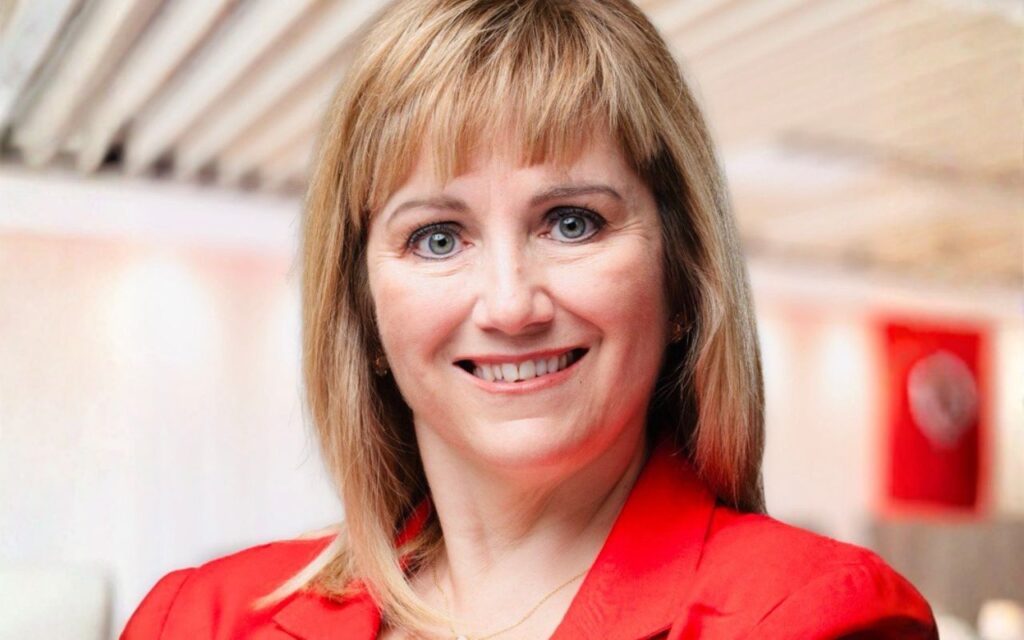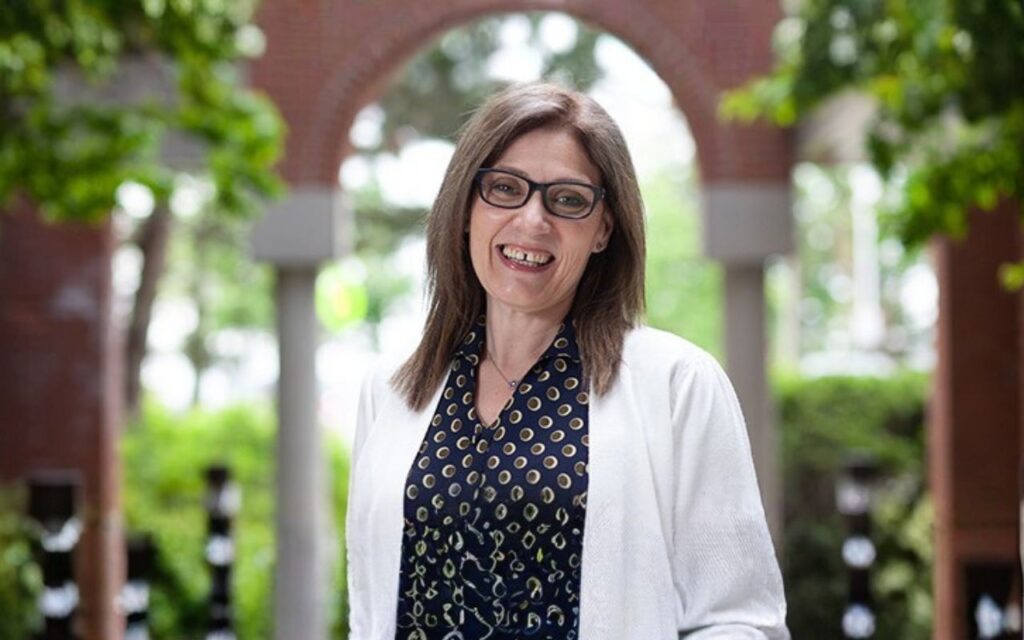


Jennifer Stewart: Devinder, I want to take it back just a little bit. Tell us about your upbringing. Who were your biggest influences growing up, and how did those people impact your career?
Devinder Gill: I grew up in a hardworking immigrant family. My parents came to Canada with very little, but with so much determination and pride. Watching them build a life from the ground up taught me so much – the value of resilience, humility, and gratitude.
My dad was incredibly disciplined. If he said he was going to do something, he did it. And my mom showed me what it means to be there with care.
Catherine Clark: So when you were a little girl, what did you think you were going to be when you grew up? We all have these big ideas. Was banking yours?
Devinder Gill: You’ll hear this from a lot of bankers – it’s usually not banking. But I’m glad I landed where I did. I always thought I’d be a teacher. I love learning, and I still do. I’m thirsty for knowledge, for new ways and new ideas.
But more than that, I loved the idea of helping others discover their potential. And that hasn’t changed. So I guess I did become a teacher – maybe not in the traditional sense, but through mentoring and developing people. That’s become one of the most rewarding parts of my career.
My yearbook might say accountant or banker, but I don’t think I knew exactly what that meant at the time. I’m just glad I landed where I landed.
Jennifer Stewart: I think it’s so hard for kids to figure out what they want to do in high school. There’s such an expectation. Talk to me about your first job. What was it, and what did you learn from that role?
Devinder Gill: Well, I had a very quick high school job as a typist, and I think I learned a lot of discipline – and great posture – from that.
But my first official job was working at an aluminum smelter during the summers while I was in university. The first and second summers were tough, physical work. It taught me discipline, resilience, and the value of showing up and doing the work, no matter how challenging it was.
By the third summer, I really lucked out. I had the opportunity to assist in planning the smelter’s 40th anniversary celebration. Looking back, that experience was incredibly meaningful. It allowed me to connect with the plant’s history – my dad worked there – and to really see the impact it had on the community.
That celebration was about people and purpose. It had so much heart. And it’s still what I value in my work today.
Catherine Clark: You didn’t end up in banking right away, and the aluminum smelter is an interesting start. You’ve chosen sectors and worked in environments where women aren’t necessarily the dominant population. That likely meant being the only woman in the room many times. Can you talk about what that’s been like as your career has evolved?
Devinder Gill: I think we’re in a wonderful place now. And I’m glad that I was sometimes the first woman, or the first South Asian person, walking into a meeting where the existing team or leaders had a very different perspective.
Early on, I often didn’t speak up because of that. I remember coming home after one of my first meetings and thinking I had made a big mistake by taking that role. There were a few tears. But after reflecting, I realized I had to learn how to pave the way for my voice to be heard in spaces where people weren’t used to hearing diverse perspectives.
At the end of that first meeting, a leader actually reached out to me. That’s where mentorship really shaped my path. That person encouraged me to stay the course. From that moment on, I made conscious decisions to show up with more confidence, to stand behind my ideas, and to use my seat at the table to open doors for others who might feel unheard.
I use the word resilience a lot, but it truly helped me find my voice and be part of the conversation. And that voice can change cultures. It’s about representation, but it’s also about participation.
There were many times at leadership tables where it was just me. Now, I see so many more opportunities – an abundance of inclusion and an abundance of ideas at the table.
Jennifer Stewart: What kind of tangible tools or tricks did you use to start using your voice? We hear that phrase a lot – “I started using my voice” – and it’s certainly true, but there’s a whole pathway between feeling like you can’t speak up in a meeting and rising to the level you have in the bank. Walk us through that pathway a bit more tangibly, so other women who don’t feel like they can use their voice can glean some lessons.
Devinder Gill: Absolutely. I would say there was definitely more preparation that I did going into meetings, especially when I felt unsure. There was also a bit of a pep talk with myself – asking, “What’s the one thing I’m going to contribute?”
For a long time, I was asking myself, “Should I even be at the table?” I started to shift that internal conversation to, “Yes, I should be at the table – and what am I going to learn when I speak up?” Those small nuances, even testing and challenging myself internally, really mattered.
One of the first things I did was simply show up and allow myself to be vulnerable. I would say, “I don’t know,” and recognize that I had a great opportunity to learn as well. That helped take away the fear of not knowing everything. I think, especially in environments like this, we feel we need to be perfect in order to belong. But perfection isn’t what builds trust – authenticity is.
Those pieces really helped me show up with more confidence, be present at the table, and continue building my voice. Along the way, I also found wonderful formal and informal mentors who helped me develop patience and understand the timing of when to speak up. That tension actually taught me a lot over the years.
Catherine Clark: Can you build on that a bit? You’ve mentioned mentors a few times, and they’ve clearly been important to you personally. You’ve also paid it forward by mentoring others. What were some of the specific things you relied on your mentors for? You mentioned timing – what does that mean? And what other examples can you share, so listeners have a reference point for their own journeys?
Devinder Gill: Absolutely. One thing I probably could have done more of earlier in my career was being intentional about finding good mentors. I was fortunate to have people along the way who helped and supported me, including what I’d call informal mentors.
These were people who tapped me on the shoulder and said, “Devinder, have you thought about this opportunity?” Often, it wasn’t something I would have considered on my own. They would say, “This may feel out of your wheelhouse, and it may not seem like the obvious next step, but it’s an opportunity you should think about.”
I remember individuals like that all along my journey. Some of those relationships weren’t formalized, and some are people I rarely speak to now. However, I still remember the role they played at that moment in my career – mentoring me and offering insight when it mattered.
Because of that, I’m very conscious now of creating opportunities for others. That might mean bringing more people to the table, building more robust staffing routines, and ensuring there are more voices involved, even in staffing decisions. These experiences showed me that opportunities exist if you’re willing to look for them – and people did that for me.
So now I often ask: if we have two candidates for a role, why don’t we have four? If there isn’t diversity in the candidate pool, why not? Where’s the opportunity? Whether those mentors were long-standing relationships or there for a specific period of time, they shaped how I show up as a mentor today and hold me accountable to paying it forward. Someone once believed in me, tapped me on the shoulder, and encouraged me to take a chance – and I never forget that.
Jennifer Stewart: Is there someone specific who mentored you that you’d like to give a shout-out to?
Devinder Gill: My first branch manager. We’ve probably lost touch over the years – this was almost 30 years ago – but she was a female leader and a real advocate for me. What she taught me was to speak up for myself and to be bold.
During the year and a half I worked with her, she made sure I had every opportunity within the organization to learn, to practice, and to stand up for myself. She was so invested in my growth – to the point where I think she even wanted to set me up on a couple of dates. She genuinely wanted good things for my life. I still fondly remember that first leader.
Catherine Clark: You mentioned being a diversity defender, which has clearly been an important part of your career. You’ve also talked about being the only South Asian woman in the room at times. There’s a lot of pushback around diversity right now, and it’s a very interesting moment we’re living in. How are you still pushing this forward to ensure the table around you reflects the community you serve?
Devinder Gill: That’s a great question, and you’re right – we’re at a crossroads when it comes to diversity and inclusion. But it still comes back to the fundamentals: making sure voices are heard.
I’m passionate about asking the tough “why” questions. Where is the pipeline of talent? Who are we nurturing as future leaders? And they may not look like traditional bankers – I’m not a traditional banker, as we talked about earlier.
It’s about ensuring there’s a deeper pool of candidates, with both men and women, and individuals from diverse backgrounds. It’s also incumbent on us, during interviews and recruitment, to look beyond the CV or resume. Not just the most recent role or a narrow set of experiences, but the full, robust experiences people bring – from different industries, countries, and perspectives.
Over the past decade, I’ve also leaned more into using case studies during interviews so candidates can demonstrate who they are in real-time, in real-life situations. That tells you so much more than words on a resume.
It is a different time, but we still need to overcome the hurdles of bringing more individuals and more diversity of thought to the table. And I believe it’s incumbent on leaders like myself to ask the right questions, challenge the status quo, and ensure there’s real depth and intention when we hire and recruit.
Jennifer Stewart: I’m really intrigued by how people define success. For me, it feels like an ever-evolving construct that has actually simplified over time – both personally and professionally. At this stage in your career, Devinder, what does success look like to you personally, and what does it look like professionally?
Devinder Gill: I absolutely agree with you. As you gain perspective over time, you’re reminded of who you are – both professionally and personally. For me, my family has always been my foundation. When things get noisy, I’m deeply grateful that they’re there.
A couple of things now define success for me. I’ve learned that slowing down isn’t the same as falling behind. Earlier in my career, I equated momentum with progress. Now, I realize that taking time to pause and reflect actually makes me a stronger mother, wife, sister, and daughter – and it also makes me a stronger leader.
That shift has been a big part of my success. Slowing down in order to speed up has really changed how I show up. I don’t call it balance – I call it choices. Sometimes the priority is family, and sometimes it’s work. But reminding myself of who I am, personally and professionally, and allowing myself to slow down without guilt has been incredibly important.
Catherine Clark: Staying on that theme – you’re a professional leader, but you’re also a mom, a wife, and a community member. How do you manage the combined weight of expectations that come with all of those roles? You’ve used the word “choices” rather than balance – how do you actually do that?
Devinder Gill: It’s not easy – and that’s probably the honest answer. I think that’s why I don’t really use the word balance, because in many phases of a career, it just doesn’t exist. What I do try to do is take time to reflect and make conscious decisions about where I need to be in the moment.
I’ve also moved away from perfection – from always trying to get it right. Sometimes you learn more from the things that don’t go exactly the way you planned. Being humble, being vulnerable, and allowing those moments to happen has taught me a lot.
I say this often to my team, and I say it to my daughters as well: I think I’m superwoman for everything I do day to day, but I’m not superhuman. I’ve learned when to ask for help, and I hope I model that for others. I think one of our biggest challenges, especially as executive women, is trying to do everything – at work, at home, in the car, on the sidelines. Sometimes you simply need to lean into your team or your family and ask for support. That vulnerability can be transformational – just stopping, pausing, and saying, “I need a moment.”
Jennifer Stewart: I want to follow up on that, because burnout is something so many women in my circle are talking about right now. I’ve never heard it discussed this openly. In your role, we see how much you’re out – speaking, attending events, giving remarks – on top of your leadership role at the bank and your day-to-day responsibilities. How do you manage not to burn out? And what do you do for yourself?
Devinder Gill: Thank you – that’s a great question. I’ve learned to give myself grace. I don’t always do it often enough, but I have learned to say, “I need to take this morning to work out,” or “I need a breather.” There’s a constant pressure to be everything to everyone, and I’ve realized you can’t truly be present when you’re doing that.
It really does take a village. And again, being present is more important than being perfect. Sometimes that means stepping back, asking for help, and leaning on your team. Over 30 years in leadership roles, I’ve learned to rely on my teams – and more recently, I’ve learned to lean more on my family, my husband, and my kids. They’re independent little human beings now, and I don’t need a checklist for everything anymore. I’ve had to let go a bit.
It isn’t easy, but I do give myself grace – and that’s made all the difference.