
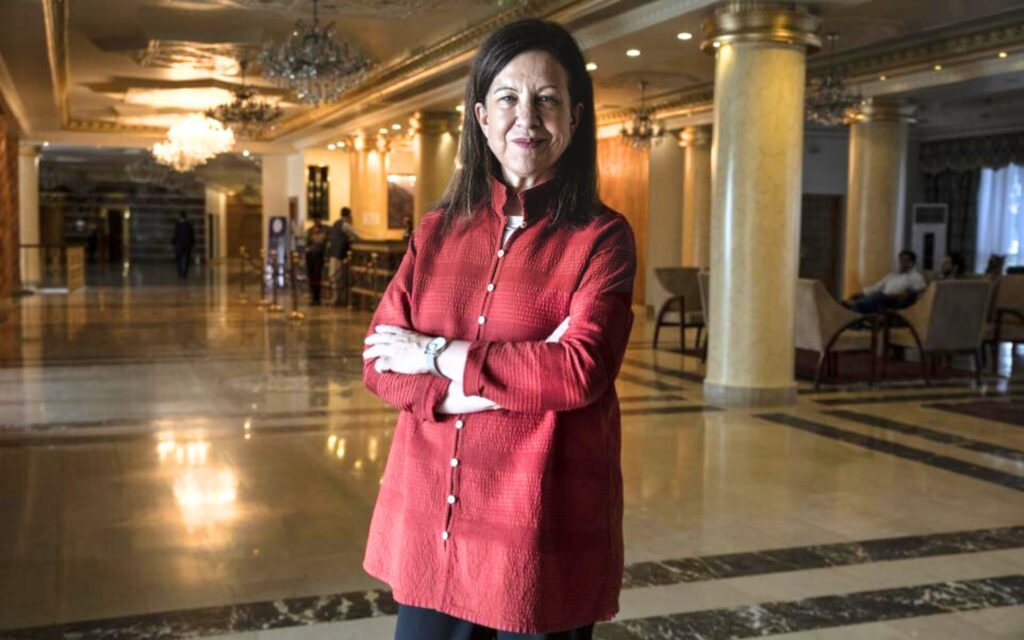
For decades, BBC’s Chief International Correspondent Lyse Doucet has reported from some of the world’s most complex and challenging corners. In her latest book, though, she shifts focus from major news headlines to the human stories behind them.
The Finest Hotel in Kabul shines a light on the lives of ordinary people navigating extraordinary circumstances in Afghanistan, with the legendary Hotel Inter-Continental as its backdrop – the country’s first luxury hotel which was often a gathering place for the international press corps who covered the conflict. Through vivid storytelling, Doucet takes readers inside the homes and communities of the hotel staff, showcasing the people behind the headlines.
We sat down with Doucet to hear more about what drew her to these stories, how she approached telling them, and how sharing these human experiences can help readers connect with people who might otherwise feel far away.
THT: If you were telling someone about the book for the first time, how would you describe it?
Lyse Doucet: This is a journalist’s attempt to explore a different kind of storytelling – one that goes beyond snapshots of the worst of times in the wars and conflicts of our time, and tries instead to convey how people find an everyday courage to carry on.
I’ve often seen my job as a foreign correspondent as narrowing the gap between you and me, and focusing on the ties that bind rather than those that pull us apart. These are stories of mothers and fathers and children and families and homes and streets and neighbourhoods, cities and countries, rich and large. They are stories we can all understand.
THT: What sparked the idea for the book?
Lyse Doucet: I’ve been going to Afghanistan for many, many years – for decades, in fact. I was told early on, when I started travelling after graduating, that cities are like people: you decide very quickly what kind of relationship you’re going to have with them, and whether you like them. My relationship with Kabul was that way, and so was my relationship with the Afghans I met.
I was immediately struck by their sense of self. My experience has been that people with a sense of self – and I’d include Canadians in this – also have a strong sense of humour, because they can laugh at themselves with confidence. They know who they are, so they can poke fun at themselves. Afghans have that in spades. And for all that has been lost in Afghanistan – and much has been lost – they haven’t lost their deeply ingrained sense of hospitality.
When you choose to write a story, you have to think about the right time to write it and how you will write it. It can’t just be a wash of information. So I asked myself: what kinds of stories am I drawn to? Every time I’ve gone to a new place and met new people, I always turned to novels, to what we call narrative history. It was the best way to immerse myself and better understand a place and a people I was getting to know for the first time.
So when I started writing, I would sometimes stop mid-flow at the computer and ask myself: Why am I writing it this way, using the conventions of fiction to tell a nonfiction, true story? And it was because I believe this is the kind of literature that draws me in and draws me toward other people. And I hoped readers would find the same.
THT: There’s so much information in the book, so many personal stories and details about the characters. How long did it take you to pull all of this together? What was that process like?
Lyse Doucet: I still wake up and think, “Oh my God, I better do some writing today.” And then I remind myself, no, it’s finished!
I signed the book contract in February 2021 – I was in Kabul then – and every year since there has been a major war, so I had to keep going back to my day job.
People talk about “stealing time.” I had to reorganize my life. When I’m on the road, I can’t write – the BBC demands so much that from the moment you open your eyes in the morning until you close them at night, there’s no time, no headspace. But when I’m in London, or when I go home to New Brunswick, which I try to do as much as I can, then it was writing early in the morning, writing on weekends, writing sometimes in the evening. Although, like many writers, I prefer the morning!
Throughout this process, I worked really closely with my Afghan colleague and friend, Mahfouz Zubaide. He was with me either physically or, when we couldn’t get to Kabul because of COVID or the security situation, online. He was there for all the interviews. He wasn’t just translating from Dari and Pashto – the two main national languages – but helping me understand the experiences and emotions of Afghans living through times like these.
It took a long time because I first had to get the history of Afghanistan right. Even though I’ve lived through much of it, it spans over 50 years. On top of that, I had to understand how a hotel runs – what the housekeepers do, what the managers do. And finally, I had to understand it all through Afghan eyes. So: layers upon layers upon layers! We spent hours and hours. Some of the people in the book I’ve known for many years, and I lived through those experiences with them. Others I knew, but I didn’t know their stories that well. So in a capsule: it took a long time!
THT: You obviously worked in Afghanistan as a reporter, covering the news. I was curious: By taking this person-first approach to storytelling, did it change the way you thought about some of these events you were actually on the ground for?
Lyse Doucet: Well, it brought me closer to understanding the lives of Afghans because I looked at it in great detail. And the main people in my book have never been in the headlines. They would never be part of the news.
On October 15, 2021, for example, stories would have focused on a momentous collapse, a historic reversal of two decades of international engagement, and the return of the Taliban. No headline said: a wedding was shattered at one of the city’s main hotels; the pain of a personal life was not the news that went around the world. There’s a saying that a smaller story has the power to tell a bigger one. I loved getting these granular details of what happened on that day – a day that will go in the history books.
THT: I love that you incorporate a lot of women into the story, especially given the reversal of women’s rights that has happened within the country. Can you tell me about that decision and those conversations?
Lyse Doucet: It was really important to have women in the book because they are so much a part of Afghan society. But I also found them to be among the most interesting characters and storytellers.
One of my regrets in the book was that I could not include one particular woman’s story. I found a young Afghan woman who had risen to be a marketing manager in her early twenties. She had been educated in America and straddled both worlds. When I called her in the southern United States, she said, “Oh, the Hotel Inter-Continental! Nobody talks to me about that anymore! I love that hotel.” We spoke for four hours. Then again for three hours.
She had an encyclopedic memory. She drew the first floor for me, told me what the suites looked like. She was a gift.
But then she disappeared for a year. When I finally reached her, I asked for her permission to use her stories. She said she couldn’t be in the book. It was too traumatizing. Those early memories, which had been beautiful, brought her back to a time she loved, a time when she loved who she was. But those beautiful memories became painful memories for her. It was emblematic of Afghanistan’s turbulent history – the highs and the lows. I lost that character, and for an evening, I felt terrible. But then you start again.
I turned instead to a British woman working at the hotel. She had vivid memories of French fashion shows, the models, the details. She brought a different perspective. But it was really important to me that there be a woman’s voice, a woman’s perspective, because women see it differently.
THT: What do you hope readers take away from the stories in this book?
Lyse Doucet: I hope they will find a story that makes them smile, a story that brings a tear, a story that brings them closer to understanding how people who live lives like they do – and still do – in Afghanistan find the courage to carry on.
THT: And after a lifetime of asking questions through your work, what is the question you find yourself still trying to answer?
Lyse Doucet: How to keep finding hope. I think it’s really hard to live without hope. Hope is the fuel that helps us get up in the morning, get through the day, and look forward to the next day.
What we are seeing in our time are the so-called “forever wars,” wars of such intensity and immensity that even in wars there used to be rules, and now rules are being broken on an industrial scale. In these hardest of times, it’s hard to find hope.
But I really believe that if you stop hoping, you stop trying to find ways to find hope. In both big and small ways, we have to try to find it in our lives. Because, in effect, to give up on hope is almost to give up on being human.